Thursday, February 24, 2011

Visitors of the Week: Steve and Linda Pautz from Norfolk, Virginia


We're always looking to learn about the many, diverse visitors who stop by the Tenement Museum each week. Planning a visit? Send us an email to be our next Visitor of the Week.

Our latest Visitors of the Week come to us from Norfolk, Virginia. Steve and Linda Pautz demonstrate that you can take a person out of New York, but you can’t take New York out of a person. After uprooting from New York City in the mid-1970s, the couple relocated to Virginia. Visiting the Tenement Museum has the Pautzes reminiscing on their own histories here in the Lower East Side.

Steve: We like the TV show “Cash Cab” on the Discovery Channel. It’s a game show in a cab. We were watching it, and a customer got in the cab and said ‘take me to the Tenement Museum.’ We had never heard of the museum before that, but my parents both grew up in tenements. My Dad went to Seward Park High School, which is just a couple of blocks away from here. This is where my roots are, so to speak.

Did you see any connections in our tenement versus the spaces that you remember from your childhood?

S: Absolutely. Not only do I remember parts of the tenement building itself, but we also used to shop here on Orchard Street.

Linda: My mother and I used to come down here when I was growing up. She’d do all her big shopping on Orchard because back then it was mostly run by local Jewish people. They were wonderful storekeepers, and they also had a great tradition. If you were the first customer of the day they had to make that sale. If they didn’t it was bad luck for the rest of the day. My mother knew that, and she would be camping out at the storefront. She was usually shopping for ladies’ undergarments. She would argue and say, “No, I’m not paying you $10, I’ll give you $5.” When they declined she’d take her things and leave, but then they would drag her back in and say, “Okay, we’ll give it to you for $5.”

Has it changed a lot from what you remember?

L: You know, it has and it hasn’t. It doesn’t look all that different.

S: As the neighborhood has changed from different groups moving in – German, Jewish, Latino, and etcetera, we come back to the city fairly often and see that things have changed but at heart it’s still the same.

Definitely. So which tour did you go on today?

L: “Getting By.” It was great.

S: A lot of the stories from the Italian family are ones that my wife remembers hearing from her grandmother growing up.

L: And just even the photos up in the apartments. Our Lady of Mount Carmel was very popular in Italy, and they would have a feast as they now have throughout the city of New York. I remember going to that and enjoying all of the wonderful food. My mother came from a small town in Italy where they celebrated, so it brought back lots of memories.

S: And my family is German, so…

How funny. Considering both groups are represented in that tour, that’s quite a coincidence. Do you have any other plans while you’re in town?

L: We’re seeing some plays. We’re seeing “Memphis” tonight, and we saw “The Addams Family” last night, which was fun.

Posted by Amy Ganser

Tuesday, February 22, 2011

What is in a Photograph?: Educator Jason Eisner on the Past and Present Program

During the dialogue component of the Past & Present (P&P) program, where we share, bring to life, and re-examine our memories, we frequently use a space in our historical Tenement informally known as “the parlor.”  Three decades ago, “the parlor” space was a storefront. Generations before that it served as an apartment -- a home to countless numbers of immigrant families. Walls were removed and painted innumerable times, locks were changed, plumbing and electricity installed, but being in this parlor you might think it had originally been designed as a communal meeting place.
      
The tables in the parlor are akin to the kind my grandmother had (tin topped with enamel-ized patterns and faux wood gaining), lined end to end like a banquet, and the chairs are all mismatched. There is a sense of collective memory in this parlor. Framed old photographs line the pink painted walls. 
      
I return time and again to the photographs on the wall -- images of people and times long gone but ever present. There are moments where discussions in the parlor heat up and the exchanging of memories provokes debate. Silently bearing witness to these rich dialogues are those people depicted and framed on the wall.
      
“Who are they? Where did they live and what did they do? Who took the picture -- A parent? A lover? A stranger? What became of them? And what was their story?” These are questions I have about the pictures, and in the quiet moments when I am cleaning the parlor at the end of our discussions, I am haunted by the idea that perhaps the people in the photographs are asking the same questions about us.
      
Photographs, like history, are slippery when you begin to look more closely. The stories they tell or conceal are not static; rather they are alive and fluid. We all have a collection of photographs and those images serve as a record of our memory. These pictures punctuate the stories we tell of our families and our history, but they may be suggesting an alternative narrative. Dare we look closer and ask of those silent mouths and far away eyes?
     
At two points during the tour portion of the P&P program, we share photographs of the families whose stories we tell: Natalie Gumpertz and Josephine Baldizzi. If we engage with the pictures of these women, we can more personally connect to their life.
      
Natalie Gumpertz is depicted wearing an elaborate Victorian style shirtwaist. As a dressmaker herself, did she make the garment she is wearing for the photo? Would this be a garment she would wear for only special occasions? Rather than looking directly at the camera, she is looking slightly to the right. Was she instructed to do this?  Or perhaps she was frightened by the photographic process? Her eyes do not betray a sense of fear. Could she have brought one of her children with her and was focusing her attention on what they were doing beyond the lens of the camera? And it looks as though she might speak, her lips caught between smile and austerity. Could Natalie be about to tell us her last memory of her husband before he vanished from her life?
Josephine and Johnny Baldizzi


And there’s Josephine on the roof with her brother Johnny- she in her summer dress, and he in his sailor suit. Are these clothes that they only wore on special occasions? Why is Josephine sitting in the picture while Johnny is standing? Was she taller than he? Is this a composition Adolfo (their father and presumed photographer) was responsible for? Was Josephine happy about the composition -- her head is turned away slightly, but her gaze is fixed on the camera. She is almost scowling! Did her father have strong words with her about her protest?

Ultimately we will never know the answers, but if we open ourselves up to the inner drama of the picture, we are overtaken by it.

Likewise, by engaging history through the filter of the families who endured it, we intimately connect to the past. The P&P program allows us to expand this connection and to add our personal narratives to it. In the process is the discovery that we are not very different from people who lived one hundred fifty years ago; immigrants from Germany, Russia, Italy, or China who worked through hardship and who suffered, who lost and found jobs just as they gave birth to and lost children, who lived and loved, argued and made amends, and died in rooms.


There are revelations along the way, old myths and preconceptions shattered, and all of this because we dare to ask questions of our past. It is challenging but essential work in continuing the search for identity. For encouragement, I take heart in the words of a German immigrant whose picture I used to have on my refrigerator -- he was standing on the streets of New York sticking his tongue out at the camera: “Learn from yesterday, live for today, hope for tomorrow. The important thing is to not stop questioning.” --Albert Einstein

     - Posted by Jason Eisner, Tenement Museum Educator

Questions for Curatorial - Material for Dresses

What material would the dress in the Levine family apartment have been made out of in the 1890s? How did this material differ from the material that would have been used for ready-made clothing purchased by working-class Lower East Siders?

The dress on display in the Levine apartment is a replica of a dress featured on the “Only Woman’s Page” of the New York Daily Tribune in June of 1898 (clothing was manufactured in advance of the season). The dress featured was made of organdy, the sheerest cloth manufactured from cotton, over a pink silk lining. Dresses purchased by immigrant working women on the Lower East Side were inexpensive versions of elegant, high-fashion design such as this.

Thursday, February 17, 2011

The Jewish Daily Forward on the Lower East Side: An Educator's Perspective

The Rogarshevsky apartment on our popular "Piecing It Together" tour takes our visitors into the Jewish Lower East Side of 1911. The family of eight, crowded into 325 square feet, likely spent most of their daytime hours at work or on the street. It's very likely that on occasion they might have found themselves on East Broadway by Essex Street. This is why a new object from that very location, a Jewish Daily Forward newspaper, has recently been added to the Rogarshevsky apartment; it illuminates the larger atmosphere of the Lower East Side at that time. Today this intersection looks very different than in 1911, but still possesses a hint of the energy that once pulsed there.

Image of the Jewish Daily Forward
Photo courtesy of BoweryBoogie.com

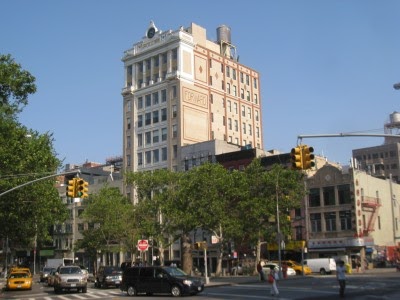
Just a few short blocks from 97 Orchard Street stands a majestic condominium building that faces Seward Park and the Seward Park Library. This triangular intersection is mostly quiet, except for the occasional taxicab or idling bus. Little does the average passerby realize that this intersection, so quiet and inconspicuous today, used to be bursting with fervent and empowering energy. With opinionated individuals, young and old, speaking their minds from a soapbox in Rutgers Square—where you might have even found a local intellectual celebrity like Emma Goldman or Eugene Debs debating the best course of action for Lower East Siders and the nation. And that majestic condo? The quiet and elegant bas-relief of Engels, Marx, Liebknecht and Lassalle engraved on the facade belies its former resident. This condo was originally home to the Jewish Daily Forward, the most influential voice in the early 20th century Yiddish-speaking East European Jewish community.

Founded by dissidents in April of 1897, the Forward became the source for information serving the working-class Yiddish-speaking population. The fifty socialists who served as the backbone for the paper were well aware, to lean on a later colloquialism, that the personal was political. Marginalized for their class status, their religion, their ethnicity, their immigrant status and most of all, for their language, the Yiddish-speaking population in the Lower East Side was most likely thought of as a backwards nuisance by uptown folks, if they were thought of at all. Out of this dismissal and disregard came a fierce drive for the community to pull itself up from within. Unlike most Victorian communities, the radical environment surrounding the Forward embraced all members of the community–women and men, young and old. In a world where conventional power eluded them, the community surrounding the Forward became a force to be reckoned with by organizing, through and around the newspaper as well as through unions and associations. These protests, walk-outs, and political actions would eventually profoundly influence New York City and the United States. Its contributors—both the professional writers and the readers who sent their letters and questions–debated the contours of American freedom and idealism and developed a strong social consciousness that advocated for many of the social protections and conventions that we take for granted today.

It's thrilling for a Tenement Museum Educator such as me to see a reproduced copy of the Forward lying on Bessie and Ida's cot in the Rogarshevsky dwelling. To me, it is a loud testament to the clatter of social action and a worthy struggle that is impossible to ignore. New York City has a proud history of civic engagement and empowerment for its citizens, but it is not there to be passively received. The Forward, folded politely on broadsheet paper, is a call to arms to the modern citizen; a reminder that no matter how oppressed you feel or how seemingly insurmountable the injustice that surrounds you, a strong and unified community can demand attention and change. It happened then. It can happen today.

--Posted by Emily Gallagher

Wednesday, February 16, 2011

The Jewish Daily Forward and the Daily Lives of the Rogarshevsky Family: Guest Post by Tony Michels -- Part II

Thanks to an NEH grant, scholar Tony Michels is advising the Tenement Museum on how we can use objects to tell stories in the Rogarshevsky family apartment. He'll be at Tenement Talks on February 17 at 6:30 pm. Here is the second in a two-part essay on how artifacts pertaining to the media have been used in the exhibit.


Image of Jewish Daily Forward headline from May 18, 1903
Courtesy of Yeshiva Institute for Jewish Research
The Forverts can also be used to reveal other aspects of immigrant Jewish life. The newspaper’s name itself provides a telling starting point. Many Yiddish readers would have noticed that “forverts” is not a Yiddish word, but a Yiddish adaptation of the German word for “forward.” This choice reflects the significant influence of German socialists (mostly Gentiles) who lived on the Lower East Side in large numbers at the time eastern European Jews began arriving during the 1870s and 1880s. In labor lyceums, saloons (perhaps even the one located at the bottom of 97 Orchard between the years 1863 and 1886), and in other places, German and Russian Jewish radicals interacted with one another. Germans exercised a formative influence on Jewish socialists, such as Abraham Cahan, who went on to become the Forverts’ editor. They offered Cahan and his colleagues (who knew little of Karl Marx and his ideas before settling on the Lower East Side) ideological tutelage, financial aid, and practical assistance in getting the Jewish labor movement off the ground. Thus, when Jewish socialists chose Germany’s Vorwarts, the leading socialist newspaper in all of Europe, as their namesake, they paid tribute to their German mentors. The Rogarshevsky family surely knew little, if anything, of this German-Jewish alliance. They arrived on the scene in a later period, when Germans had all but left the Lower East Side for other parts of New York. Nonetheless, the Forverts represents its concrete legacy.


Rogarshevsky Family
Courtesy of Tenement Museum Photo Archives

The Forverts encapsulates another important cultural development that might seem unremarkable today, but was of profound importance a century ago: the creation of Yiddish newspaper readers. At the time of the Forverts’ birth in 1897, virtually no immigrant had read a Yiddish newspaper in the old country. Censorship in the Russian Empire, where the Rogarshevskys (along with most immigrant Jews) originated, prevented the publication of Yiddish newspapers until the early 1900s. Even with the easing of censorship following the 1905 revolution, a full-fledged Yiddish newspaper market took some time to develop. The Rogarshevskys probably had never seen a Yiddish newspaper or, at least, were not regular newspapers readers in Russia. When they arrived in New York, however, the Rogarshevskys discovered a thriving Yiddish newspaper market, in which a wide variety of Yiddish newspapers were sold in newsstands and read virtually everywhere: in cafes, in places of work, on park benches, at home, and so on. And if somebody did not have sufficient literacy—as was common among older women, for instance—that person nonetheless had opportunities to hear newspapers read aloud. In the Rogarshevsky household, the father or one of the children probably read the newspaper to other members of the family on a regular basis.


Newspapers had the effect of broadening the mental horizons of immigrants. The Forverts, for instance, not only provided news (often quite sensationalistic) from near and far, but also published fiction and poetry, educational articles on history and science, and gave practical advice that helped readers navigate difficult moral and ethical problems pertaining to daily life. Learning how to read the Forverts and other Yiddish newspapers often proved difficult. Immigrants encountered much unfamiliar vocabulary regarding unfamiliar subjects. Nonetheless, hundreds of thousands of immigrants learned how to read newspapers—often with the help of friends and relatives who had arrived earlier—and, in the process, became Americanized, albeit through the Yiddish language. An American innovation, the Forverts offers a glimpse into this complicated Americanization process.


In short, the Forverts provides a crucial piece of the Rogarshevskys’ life, connecting it to the larger immigrant Jewish experience as it unfolded beyond the four walls of 97 Orchard.

The Jewish Daily Forward and the Daily Lives of the Rogarshevsky Family: Guest Post by Tony Michels -- Part I

Thanks to an NEH grant, scholar Tony Michels is advising the Tenement Museum on how we can use objects to tell stories in the Rogarshevsky family apartment. He'll be at Tenement Talks on February 17 at 6:30 pm. Here is the first in a two-part essay on how artifacts pertaining to the media have been used in the exhibit.


“Piecing It Together” vividly reconstructs the domestic life of the Rogarshevsky family, but how might we connect the Rogarshevsky domicile to the larger public arena? I raise this question because immigrant Jews spent much of their free time outside of their apartments: in parks and squares, on street corners, in cafes, and in other public and semi-public places. Unfortunately, few of those places still exist or, if they do they reveal few traces of past events. Rutgers Square, now named Strauss Square, used to be a gathering spot for young Jewish radicals, who congregated there nearly every day to discuss and argue issues of the day, but the square today gives no indication of this past. Linking the public and private realms thus presents a challenge, though not an insurmountable one.


A simple artifact—the Yiddish daily Forverts—can be used to connect the Rogarshevsky apartment to the world outside. We do not know for sure whether the Rogarshevskys read the Forverts. They could choose from no less than five Yiddish dailies during their years living at 97 Orchard. Nonetheless, we can reasonably surmise that at least one person in the Rogarshevsky family read the Forverts. This is because the Forverts was the most popular Yiddish newspaper in the United States, indeed the world. With a circulation topping 200,000 in 1917, the Forverts sold more than twice the number of copies than did its closest Yiddish competitor. Furthermore, the Forverts was not just a newspaper in an ordinary sense, but a force within immigrant public life. Its writers and editors played leading roles in Jewish communal affairs, the Jewish labor movement, New York City politics, and the American socialist movement as a whole. If an immigrant wanted to keep abreast of current events, he or she most likely turned to the Forverts (though not necessarily to the exclusion of other newspapers). Even immigrants who considered themselves traditional, religious Jews read the Forverts because they saw no contradiction between its socialist viewpoint and their Judaism. Religious articles of the kind seen in the Rogarshevsky apartment and the Forverts often shared space in a single household.

The Bintel Brief, a Yiddish advice column, began in 1906. Bintel means "bundle" and brief  means letter.
Courtesy of The Bintel Brief

Many of the events covered by the Forverts had to do with labor movement. An avowedly socialist newspaper, the Forverts’ masthead declared: “Workers of the world unite! The liberation of the working class is the task of the workers themselves!” The Forverts published countless articles on strikes, consumer boycotts, demonstrations, parades, and debates: all frequent occurrences on the streets of the Lower East Side. The newspaper did not merely report on events; it served as a tribune of the Jewish working class. Take the Forverts’ response to the Triangle Shirtwaist Fire as an example. On the day following that terrible incident, the Forverts’ front-page headline wailed: “The morgue is filled with our dead/victims! 175 workers lose their lives in a burning shirtwaist factory. The entire Jewish Quarter mourns.” The Forverts refused to adopt a dispassionate tone or removed stance. The victims were “ours.” And masses of Jewish workers, who knew firsthand the hardships and abuses of the garment industry, looked to the Forverts to articulate their grievances and lead the way…forward.


The March 26, 1911 copy of the Forverts thus opens up the Rogarshevsky apartment, bringing to bear one of the major events of the immigrant era. The presence of the newspaper invites us to imagine how the Rogarshevsky family might have reacted and discuss the public outcry that followed, culminating in the reform legislation passed by the New York State Assembly as a result.

[Part II will be posted later this afternoon]

Tuesday, February 15, 2011

Heart of the City: Nine Stories of Love and Serendipity on the Streets of New York with Ariel Sabar

Anyone could tell you I’m not really into love stories. I like funny movies and depressing books. I love New York because I’m single more often than not, and because New York is the greatest place in the world to be single. So naturally, my first reaction to this year’s Valentine’s Day event, as every year, was an eye roll. Love in New York, sure, great.

I was more shocked than anyone to find myself drawn against my will into the premise of Ariel Sabar’s new book Heart of the City: Nine Stories of Love and Serendipity on the Streets of New York. Sabar, inspired by his parents having met in Washington Square, “set out to find the invisible forces at play in great public places.”

In a city of more than 8 million, the chances of two people finding each other seem slim, and Sabar admits that only a tiny percentage of couples report having met in a public place. Sabar details nine real-life love stories in narrative, novelistic form, introducing each character just before they run into each other (sometimes literally) on the subway, in a park, in the Met, on the street, or in a park.

The book’s introduction was a surprise pleasure; a fascinating discussion of how city planners use the built environment to draw people together, from Gilgamesh to Jane Jacobs’ New York and beyond. People need places to gather, and people, it seems, attract more people. No matter the location, Sabar is right in insisting that “there is an undeniable poetry to love born of chance.”

Join us tonight, February 15th as Ariel Sabar waxes philosophical on love and urban planning. I’ll be in the back, pretending not to enjoy it.

--Posted by Kat B.