Learn more about the businesses that operated our of 97 Orchard Street in the second half of our long conversation with Curatorial Director Dave. (Here's the first half.) He talks a lot about butcher shops and the Lustgarten family.

Showing posts with label minding the store. Show all posts
Showing posts with label minding the store. Show all posts
Thursday, January 13, 2011

Monday, December 20, 2010
And the Artifact is...

No, it's not an oil can or the Tin Man's hat. It's a sausage stuffer! Meat is packed into the larger opening of the tin tube using the big end of this smoothed wooden plunger:

The ground meat is then forced through the tin tube and comes out in long thin lines of sausage. The meat can then be tapered off every few inches to create links.
Sausage was a popular food in Lower East Side butcher shops because it was an economical treat for the customer and an efficient way for the butcher to use many parts of the animal at once. A century ago, butchers would sometimes include the scraps and organs of the animal in the meat.
Tin sausage stuffers with wooden plungers were the most practical way to make sausage before stuffers with cranks were made available. And you can still find antiques like this online for low prices if you ever feel like making dinner the old-fashioned way.
-Posted by Joe Klarl
Friday, December 17, 2010
Can You Guess the Artifact?
We came across another strange mystery object this week while preparing for our forthcoming exhibit.


This one looks a lot like something the Tin Man might've left behind here.

Hollow, with a small opening on top and a large opening on the bottom, this artifact is shaped like a wine bottle missing its base.
What could it be?
Leave your guesses in the comments and check back Monday for the answer!
-Posted by Joe Klarl
Monday, December 13, 2010
And the Artifact is...

It turns out this is actually an early food chopper. Yes, before food processors, we used this to mash our food into bits with one of these.
At the end of the nineteenth century, a food chopper like this one typically had a wood or metal handle and one or two sharp blades. As you can see in the picture above, our food chopper has a metal handle and the intersecting blades are rather dull, though age might have something to do with that. Here's another funky dual-blade design from approximately the same period, though I think ours looks sturdier.
Obviously, an artifact like this was used in the kitchen. It may even have been found in businesses like the family owned Lustgarten butcher shop that occupied the 97 Orchard Street storefront space, as re-imagined in our next exhibit.
-Posted by Joe Klarl
Friday, December 10, 2010
Can You Guess the Artifact?
We keep on scavenging for the new exhibit about historic Lower East Side businesses, and we need your help to figure out how to use all this stuff!
Our mystery artifact this week looks like a bell from afar but a closer look reveals an "X" shaped, rounded base, nailed to a heavy, metal handle.

What is this thing? Cookie cutter? Dangerous weapon?
Take a guess and find out Monday!
-Posted by Joe Klarl
Monday, December 6, 2010
And the Artifact is...
On Friday, I asked if you recognized this wooden artifact:


Did you? It's actually a tap for a beer barrel, just like the kind that occupied John Schneider's 1870s saloon at 97 Orchard Street, as featured in our forthcoming exhibit.
Unlike today's aluminum and metal kegs, the wooden barrels that occupied saloons and pubs used these wooden taps to dispense beer. A beer barrel was placed on its side in those days and the thin end of the tap was inserted into a hole on the top of the barrel. As the handle was turned, the spout would open, beer would then enter through a hole in the wooden filter and finally pour out into a bartender's glass.
Beer barrels and wooden taps lost favor in the twentieth century as metals and plastics took hold of the market. Today, some of these wooden taps are connected to barrels that hold wine and other beverages, though most modern taps, even those connected to wooden barrels, are metal. The vintage kind can be found on Ebay, like this 1930s tap found in a Kentucky warehouse.
-Posted by Joe Klarl
Friday, December 3, 2010
Can You Guess the Artifact?
Check out this artifact we bought while preparing for our new exhibit about the businesses of 97 Orchard Street:


This wooden item consists of two connected parts: its long dagger-shaped body and the revolving handle built into its side.
Some of you might be familiar with this one already. Almost any adult who lived on the Lower East Side a century ago would recognize it. A tremendous amount of businesses had one or several of these inside. So what is it?
Tell us and check back here Monday for the answer!
-Posted by Joe Klarl
Monday, November 22, 2010
And the Artifact is...
Did you guess the true use of the artifact from Friday?

This old gadget is actually a rotary knife sharpener!


This old gadget is actually a rotary knife sharpener!

A knife sharpener like this one would have been used in the Israel Lustgarten butcher shop at 97 Orchard Street during the 1890s, which will be featured in our upcoming business exhibition. The end would have been nailed onto a counter top or workspace. Then, a butcher would simply line a knife up to the sturdy metal wheel and rotate the hand crank on the opposite side. Finally, the wheel would grind into the butcher's blade to insure it was sharp and effective.
Make sure to check back on Friday to guess our next mystery artifact!
-Posted by Joe Klarl
Friday, November 19, 2010
Can You Guess the Artifact?
While looking through all of the potential artifacts we can display at our new business exhibit, some are just bound to get more attention than others. I'm happy to say the mystery object this week was a favorite among the Tenement Museum staff.
What do you think it is?

Get a good look at this one before taking your guess.

Tell us what you think and find out on Monday if you're right!
-Posted by Joe Klarl
Monday, November 15, 2010
And the Artifact is...
On Friday, we asked you to guess what this artifact is:

Here it is unfolded:

A century ago, these practical devices were typically used in trunks aboard steamships to America (though it's doubtful that the poorer immigrants to America would have had access to them).
Of course, hangers similar to this aren't odd today. You can find plenty of different collapsible clothes hanger designs on sale, typically made of plastic but otherwise very similar to our artifact.
Remember to check back Friday for another chance to guess the artifact.
-Posted by Joe Klarl
Friday, November 12, 2010
Can You Guess the Artifact?
While rummaging through the museum's collection for our upcoming exhibit, we found another cool artifact for you this week. Take a look:

This shiny metal object is surprisingly compact and might come in handy even today.
What do you think it is? Let us know your guess, and check back Monday for the answer!
-Posted by Joe Klarl
Friday, October 29, 2010
Can You Guess the Artifact?
We've got another artifact from our forthcoming exhibit for you to think about this weekend!
Shaped like a paddle and adorned with small curved prongs, this thing would be pretty intimidating if it didn't measure in at only a few inches.

Back scratcher? Fly swatter? Letter opener?
It's got me perplexed. What do you think?
Tell us over the weekend and find out Monday!
- Posted by Joe Klarl
Tuesday, October 26, 2010
All Eyes (and Hands) On Our New Exhibit
We've got plenty of cool stuff planned for our new tour about 97 Orchard Street's businesses, but one especially exciting component allows curious visitors to get handsy with the past. Typically, we have to be pretty strict about guests touching museum artifacts since many of them are rare or fragile. But for this exhibit, we've brought in a number of historic artifacts that visitors will be allowed to touch.
Sarah Litvin, our education coordinator for living history and access, is helping curate these handling objects for the exhibit. Recently, she asked some of us at the Tenement Museum to choose the objects we personally found most alluring. We didn't get any info on what these objects are or what kind of stories might be connected to them - we were just asked to pick those that spoke to us.
Here's what I liked:
 Keys follow a person everywhere and are a direct link to every important place in his or her life. So what better way is there to acquaint yourself with someone than to look at their keys? These feel just like they look: a great jumbled, jangling mess.
 As a former trumpet player, this one is personal. I have to hear this thing! It's a light, little instrument and its finish is very worn. I can only imagine the music and stories behind it.
 I was immediately drawn to this postcard, dated October 24, 1911 and delivered to Mr. Waldo Little at 31 Mulberry Street. I like any primary historical document that you can see and read, so I loved this. With its visible horse drawn carriage in the background and its old ink, it's in surprisingly good shape too.

I chose this wallet because I could feel the old leather, snoop around inside, and take a look at the person who owned it. Mrs. Helen Lee's wallet felt very similarly to my own nearly a century later.
Sarah's curatorial work is based on personal experiences and preferences, but it doesn't end with us. You'll be able handle artifacts the same way we did, toying around with whatever your eye catches. And you'll learn something too!
So what will you choose? Decide for yourself when our new exhibit opens next year.
- Posted by Joe Klarl
Sarah Litvin, our education coordinator for living history and access, is helping curate these handling objects for the exhibit. Recently, she asked some of us at the Tenement Museum to choose the objects we personally found most alluring. We didn't get any info on what these objects are or what kind of stories might be connected to them - we were just asked to pick those that spoke to us.
Here's what I liked:


Sarah's curatorial work is based on personal experiences and preferences, but it doesn't end with us. You'll be able handle artifacts the same way we did, toying around with whatever your eye catches. And you'll learn something too!
So what will you choose? Decide for yourself when our new exhibit opens next year.
- Posted by Joe Klarl
Friday, October 22, 2010
Can You Guess the Artifact?
We keep finding fascinating artifacts for visitors to handle when they stop by our next exhibit about the businesses that occupied 97 Orchard Street.
This is the strangest and scariest among them. A loose, sharpened spike inside of a metal disk, we approached this one with caution.
Here's a few hints:
It's pretty heavy for it's small size.
The spike can rotate and be pulled out of the casing surrounding it.
And the disk reads "Griswold American 6 in."

So what is this mysterious object?
Take a guess and find out on Monday!
- Posted by Joe Klarl
Friday, October 15, 2010
Can You Guess the Artifact?
We've prepared a lot of nifty artifacts for you to touch and discover once "Minding the Store" is open to the public. A lot of our collection isn't even recognizable to people today.
But you have to know what the artifact is before you can learn the story behind it.
Can you guess what this strange contraption is?

Tell us what you think and find out the answer on Monday!
-Posted by Joe Klarl
But you have to know what the artifact is before you can learn the story behind it.
Can you guess what this strange contraption is?

Tell us what you think and find out the answer on Monday!
-Posted by Joe Klarl
Monday, August 16, 2010
Meet the Lustgartens
As part of its research for “Minding the Store,” the Museum is working to locate the living descendants of 97 Orchard Street’s shopkeepers, particularly those whose stories will feature prominently in the exhibit itself. One of those shopkeepers is Israel Lustgarten and his family.
In an unrestored, partially-furnished “instructive ruin” apartment, we will tell the story of the Austrian-Jewish Lustgartens and their kosher butcher shop, which was located at 97 Orchard Street c. 1890-1902. In 1899, it was one of 131 kosher butcher shops on the Lower East Side. During the May 1902 kosher meat riot, the front window of the Lustgarten butcher shop was smashed.
Recently, with the assistance of Research Intern Danielle Charlap, the Museum located Louise Almy, who is the great-granddaughter of Israel and Goldie Lustgarten and the granddaughter of Fanny Lustgarten and Louis Graubard, who also worked in his in-laws' butcher shop. Now living in California, Louise has donated several photographs featuring the family, a sample of which appears below.
The patriarch of the Lustgarten family, Israel hailed from town of Stanislau, Austria in what is today Galician Poland. Sometime in the early 1880s, Israel, Goldie, and their six children left Stanislau for New York.
In 1889, the Lustgartens left 262 Broome Street and moved to 97 Orchard Street. That each member of the family appears with an apron in the photo above suggests the degree to which the Lustgarten’s butcher shop was a family business.
If you look closely, you can see that Goldie is wearing a sheitel or wig, which suggests that the family was observant. This might have been as much a business strategy as a religious disposition; observant customers would have sought out and patronized observant kosher butchers.
In 1889, Israel and Goldie’s eldest daughter, Fanny, married Romanian-born butcher Louis Graubard at the Eldridge Street Synagogue. Museum researchers believe that Louis worked in his father-in-law’s butcher shop at 97 Orchard Street and that he and his wife also took up residence in a separate household in the building. Indeed, the married couple’s first two children, Simon and Meyer Graubard, were born at 97 Orchard Street, in 1892 and 1895, respectively.
Louis later went on to become a political operative in Tammany Hall and served as the Democratic captain in the Ninth Election District of the Eighth Assembly District.
-Posted by Dave Favaloro, Director of Curatorial Affairs
In an unrestored, partially-furnished “instructive ruin” apartment, we will tell the story of the Austrian-Jewish Lustgartens and their kosher butcher shop, which was located at 97 Orchard Street c. 1890-1902. In 1899, it was one of 131 kosher butcher shops on the Lower East Side. During the May 1902 kosher meat riot, the front window of the Lustgarten butcher shop was smashed.
Recently, with the assistance of Research Intern Danielle Charlap, the Museum located Louise Almy, who is the great-granddaughter of Israel and Goldie Lustgarten and the granddaughter of Fanny Lustgarten and Louis Graubard, who also worked in his in-laws' butcher shop. Now living in California, Louise has donated several photographs featuring the family, a sample of which appears below.
 |
| Portrait of Israel Lustgarten, date unknown. Collection of the Lower East Side Tenement Museum. |
The patriarch of the Lustgarten family, Israel hailed from town of Stanislau, Austria in what is today Galician Poland. Sometime in the early 1880s, Israel, Goldie, and their six children left Stanislau for New York.
 |
| The Lustgarten Family c. 1887 in front of their 262 Broome Street kosher butcher shop. Pictured left to right: Goldie (mother), Fanny (daughter), Joseph (son), William (son), Bertha (daughter), Rebecca (daughter), and Israel (father). Collection of the Lower East Side Tenement Museum. |
In 1889, the Lustgartens left 262 Broome Street and moved to 97 Orchard Street. That each member of the family appears with an apron in the photo above suggests the degree to which the Lustgarten’s butcher shop was a family business.
 |
| Portrait of Goldie Lustgarten, date unknown. Collection of the Lower East Side Tenement Museum. |
If you look closely, you can see that Goldie is wearing a sheitel or wig, which suggests that the family was observant. This might have been as much a business strategy as a religious disposition; observant customers would have sought out and patronized observant kosher butchers.
 |
| Fanny Lustgarten, date unknown. Collection of the Lower East Side Tenement Museum. |
In 1889, Israel and Goldie’s eldest daughter, Fanny, married Romanian-born butcher Louis Graubard at the Eldridge Street Synagogue. Museum researchers believe that Louis worked in his father-in-law’s butcher shop at 97 Orchard Street and that he and his wife also took up residence in a separate household in the building. Indeed, the married couple’s first two children, Simon and Meyer Graubard, were born at 97 Orchard Street, in 1892 and 1895, respectively.
 |
| Louis Graubard, date unknown. Collection of the Lower East Side Tenement Museum. |
-Posted by Dave Favaloro, Director of Curatorial Affairs
Wednesday, March 17, 2010
A letter, revealed
Back in November, we found a letter in the basement fireplace of 97 Orchard Street. It had clearly fallen behind a wall and had sat there, untouched, perhaps as far back as 1933, when it was mailed.
 We couldn't open the letter until it had been re-humidified. Paper gets very brittle with age, and we were worried we'd rip the letter or, worse, that it would crumble into dust before our eyes.
Everyone was abuzz about what could be inside. Friends on Twitter wondered if it was a love letter, hidden where it wouldn't be found. We knew only that a man named Mr. Scher (to whom the letter was addressed) was a mentor to Max Marcus, who ran an auction house in 97 Orchard Street in the 1930s.
On our blog post, we received a couple of helpful comments. James from Inside the Apple looked up PO Box 743, the return address, and traced it to the Biddle Purchasing Company. A few months later, a man with family ties to the company wrote in with more information: "Biddle was a purchasing and buying service for the hardware trades, including Automotive, opening for business in 1879."
So, we had a purchasing company (a middleman) writing a letter to a jobber (another kind of middleman). Was it a business note? Would we find a form letter or perhaps something more personal inside?
Well, a few weeks ago we were finally able to open the envelope. And we found... an invoice and packing slip. Hmm.

All we know about New Aseptic Laboratories is what a quick Google search turned up - that they were a Columbia, South Carolina company that had several cases filed against them in the 1940s for " the mis-branding of absorbent cotton" -- shipping "sterile cotton" that was not, in fact, sterile. We don't know why Biddle Purchasing was sending an invoice from another company.
Okay, so after all that build up, paperwork probably seems pretty mundane. But here at the Tenement Museum, we're all about the mundane, those bits of ephemera that make up our daily lives and those of the thousands of working-class people who lived in 97 Orchard Street. It's the reason we save bottle caps, petrified bagels, love notes, sheet music, handmade scooters, and even crack vials (yup, someday we'll want to tell the story of the 1980s, too).
So yes, we think this packing slip and invoice can tell us something about work and business here at 97 Orchard Street, perhaps fill in some gap later on down the line. And you never know - something amazing could be discovered thanks to this long-lost correspondence.
- posted by kate
Tuesday, March 2, 2010
Questions for Curatorial: Business in the Tenements
Curatorial Director Dave answers your questions.
What businesses operated out of 97 Orchard Street over the years? How do you know?
The Museum's researchers use many different sources to find out about the history of our tenement building. City directory records, newspapers, factory inspector reports, and oral histories are just a few of the resources available to us when researching retail or manufacturing businesses.
For instance, the 1917 city directory records the following businesses occupying the storefronts spaces of 97 Orchard Street:
1929:
Fisher, Harry Hosiery
Fischer & Schimmel Hosiery
Orchard Printing Co.
Scher, A. General Merchandise
Schimmel, Rubin Hosiery
Solomon, L Printer
1930:
Fischer & Schimmel Hosiery
Scher, A. General Merchandise
1931:
Reliable Jobbing Co.
S & D Underwear Corp.
Scher, A. General Merchandise
1933
S & D Underwear Corp.
Scher Jobbing House
Scherm Wm Jobber
1934
Duberman, H. Handbags
Scher’s Jobbing House Inc.
Scher’s Jobbing House Inc.
Seaboard Impt. Co.
1935
Duberman, H. Handbags
Gips & Mendesohn Inc. Hosiery
Seaboard Impt. Co.
1937
Auction Exchange
Gips & Mendesohn Inc. Hosiery
1939
Brandies, Herman Auctioneer
Brandies & Marcus Merchandise
Gips & Mendesohn Inc. Hosiery
1940
Gips & Mendesohn Inc. Hosiery
Scher, Wm. Auction Outlet
Does anyone want to share what a "jobber" is? I bet some of you readers know. Or worked as a jobber even?
Some of these businesses, including the auction house, will be part of the Museum's forthcoming "Minding the Store" exhibit, slated to open in early 2011.
What businesses operated out of 97 Orchard Street over the years? How do you know?
The Museum's researchers use many different sources to find out about the history of our tenement building. City directory records, newspapers, factory inspector reports, and oral histories are just a few of the resources available to us when researching retail or manufacturing businesses.
For instance, the 1917 city directory records the following businesses occupying the storefronts spaces of 97 Orchard Street:
- Claman Stove Repair (Morris and Irving Claman)
- Orchard Printing Co.
- The dry goods store of Louis Schocken
- The watchmaking shop of Louis Rudow
1929:
Fisher, Harry Hosiery
Fischer & Schimmel Hosiery
Orchard Printing Co.
Scher, A. General Merchandise
Schimmel, Rubin Hosiery
Solomon, L Printer
1930:
Fischer & Schimmel Hosiery
Scher, A. General Merchandise
1931:
Reliable Jobbing Co.
S & D Underwear Corp.
Scher, A. General Merchandise
1933
S & D Underwear Corp.
Scher Jobbing House
Scherm Wm Jobber
1934
Duberman, H. Handbags
Scher’s Jobbing House Inc.
Scher’s Jobbing House Inc.
Seaboard Impt. Co.
1935
Duberman, H. Handbags
Gips & Mendesohn Inc. Hosiery
Seaboard Impt. Co.
1937
Auction Exchange
Gips & Mendesohn Inc. Hosiery
1939
Brandies, Herman Auctioneer
Brandies & Marcus Merchandise
Gips & Mendesohn Inc. Hosiery
1940
Gips & Mendesohn Inc. Hosiery
Scher, Wm. Auction Outlet
Does anyone want to share what a "jobber" is? I bet some of you readers know. Or worked as a jobber even?
Some of these businesses, including the auction house, will be part of the Museum's forthcoming "Minding the Store" exhibit, slated to open in early 2011.
Thursday, January 28, 2010
Shop Signs in the Windows of 97 Orchard
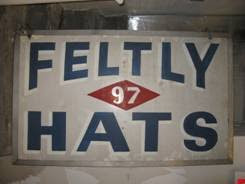
Derya Golpinar, our collections manager, and Dave Favaloro, our research manager, collaborated on two posts for the Bowery Boogie blog on the signs now gracing the windows of 97 Orchard Street. We used two signs from our collection - one for Feltly Hats and one for Chock, Inc. Head over to Bowery Boogie to read the first post today, on Minding the Store and the history of Feltly Hats.

Tuesday, November 3, 2009
Work has begun on our Storefronts exhibit!
In addition to starting work on the rear yard exhibit, we have also begun serious work on Schneider's Saloon, which has long been in the planning and research stages. If you subscribe to our newsletter, you may have read about this exhibit already.
In 97 Orchard Street's basement, from 1864 until the late 1880s, John Schneider ran a lager bier saloon. This was a place for food and drink but also socialization, political discussions, and families to spend time together. We'll be reconstructing the saloon but also discussing some of the other businesses that were once housed in 97 Orchard, including a butcher shop and auction house.
Earlier in the summer, Jablonski Building Conservation completed some architectural probes in the basement. Now we've dived in even more, removing large sections of sheetrock on the walls to see what we can find underneath. The existing historical fabric is largely intact from decades earlier. Even seemingly insignificant information (like whether a column is painted all the way around or whether there is decorative woodwork on the ceiling) can tell us how the space was used at different times in history.
We found evidence of wallpaper in the north-rear room, which is used for storage (see Chris and Bob at work in the slideshow below). This is significant because it suggests that there were rear apartments in the basement space, something the Museum had suspected but never confirmed with physical evidence. In the late 19th century, wallpaper was largely identified with residential spaces, not commercial.
In all likelihood, there were two apartments in the rear and a large storefront up front, which in the mid-19th century would have been the saloon. The Schnieders may well have lived in back. Sometime in the 1890s, it seems the storefront space was subdivided into two, but the apartments probably remained for a bit longer, and the storekeeps may still have lived in back of the store. Eventually they were cleared out completely and both sides of the basement were turned over to storefronts.
Here are some photos from the space. Later this week, I'll post more on the work.
- Posted by Kate
Subscribe to:
Posts (Atom)