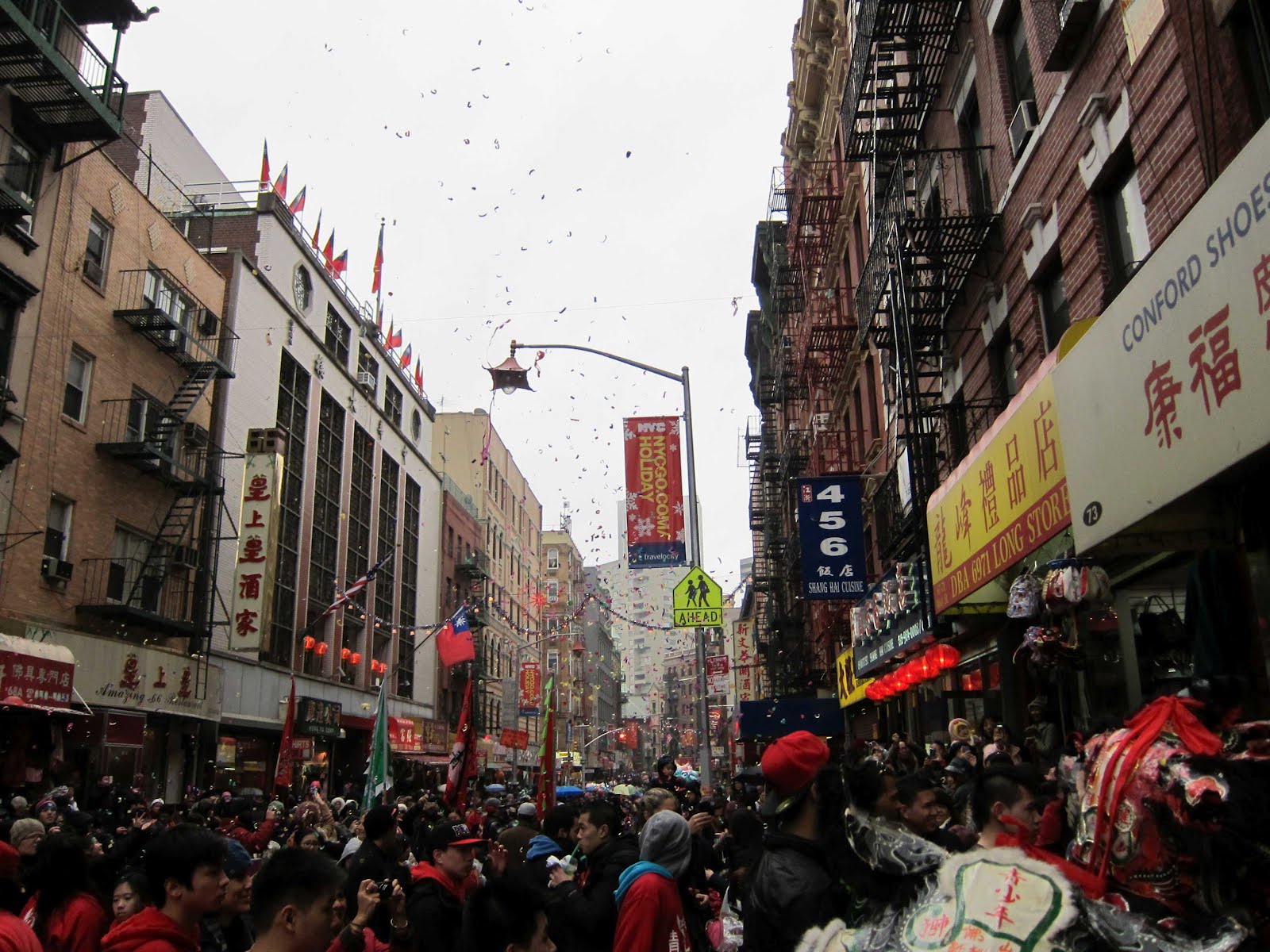
The cold wet weather didn't stop revelers from celebrating the first day of the Lunar New Year in Chinatown today. The colors and sounds of this holiday are always a welcome reprieve from the winter gloom, so we strolled over from the Lower East Side to join the party and visit our neighbors.
Kids decked out in brightly colored costumes enjoyed the excitement, clapping along to the drums and throwing confetti.
A lion dance procession made its way through the neighborhood, accompanied by drums and cymbals. The brightly colored lions (often confused with dragons) visit local shops and restaurants to bring good luck in the year to come, taking offerings of money in red envelopes from proprietors.
Happy New Year to all--may the year of the Dragon be a great one!
Monday, January 23, 2012
Thursday, January 19, 2012
From the Staff of Life to the Fluffy White Wonder: A Short History of Bread
This is the first in a series of 6 articles by Educator Judy Levin, originally written as research for our “Foods of the Lower East Side" tasting tour. During the coldest months of January and February, we're offering a modified indoor version of the tour.
Most cultures have had one complex carbohydrate at the center of their diets: potatoes or grains like rice, sorghum, corn, barley, rye, oats, millet, and wheat. Bread made from some of these cereals is one of those staples, its importance reflected in Western religions and languages: The Lord’s Prayer says “give us this day our daily bread.” The word lord is from the Old English for “keeper of the loaf.” Dough and bread are slang for money. A companion is someone you eat bread with. Long before potatoes or corn arrived in Europe, bread was the “staff of life.”
“Staff of life” bread is dark, made from whole wheat or mixtures of wheat, rye, barley, millet, and oats. German pumpernickel is whole-grain rye flour baked until nearly black. Its name—dialect for “devil’s fart”— reminds us that dark breads can be difficult to digest. But rye grows where wheat cannot, in bad soil and cold climates. Other peasant breads are “black” only in contrast to “white” loaves. English brown bread could contain rye, barley, and buckwheat. Some Italian breads included the bran and germ removed from the wheat so that whiter flour could be sold to the rich.
The desire for white(r) bread is ancient. In Rome 2000 years ago, “to know the color of one’s bread” meant to know one’s place in society. Rich people ate bread of finely ground wheat, there and elsewhere, because wheat flour develops more gluten than other flours and rises better. The wealthy French of the 1600s ate bread made whiter and lighter with the addition of milk and of yeast from brewing beer. But truly white bread couldn’t be made from stone-ground flour. It wasn’t ground finely enough and there was no technology that removed all the bran and germ—the brown part that contains the nutrients and flavor. Technological improvements in 1834 (steel rollers) and 1880s (high-speed rollers and mechanical blowers to remove bean and germ) made finer flour, but it was still faintly yellow.
By the 18th century bakers bleached flour and adulterated bread to make it whiter. 20th century Wonder Bread is the extreme outcome of the search for white bread. Its whiteness and plastic wrapping showed that it was clean, sterile, and untouched by human hands. Added sugar and chemicals speeded the baking process and created a long shelf life. By the 1920s our daily bread was truly white and then, in the 1930s, sliced and wrapped in plastic.
Stories and memoires of the immigrant experience of bread offer contradictory images. The Fleischmann family, Jews from Hungary, established their yeast company after the Civil War because they so disliked American bread that they brought over their brother—and their family’s yeast. Yet numerous immigrant narratives speak of the astonishing white bread first tasted on Ellis Island. Many children of immigrants write of being ashamed to bring their un-American homemade or dark bread to school.
By the 1960s, some Americans were rebelling against the “white bread” culture of the 1950s, seeking foods—including bread—that were healthier, tastier, and more varied than Wonder Bread. African-Americans, reclaiming their cultural “roots,” encouraged the children and grandchildren of immigrants to reconsider their own history. Assimilated European-Americans felt nostalgia for the cultures they’d left behind. Ethnic restaurants flourished. And an ad campaign showed a stereotypical Native American, Italian mama, or Asian kid eating rye bread with the slogan, “You Don’t Have to be Jewish to Love Levy’s Real Jewish Rye.” Now commercial pumpernickel is dyed brown instead of bleached white.
People have always moved from one place to another. Whether they do so as conquerors or immigrants, they tend to hang on to their basic carbohydrate.
--Posted by Tenement Museum Educator Judy Levin
Most cultures have had one complex carbohydrate at the center of their diets: potatoes or grains like rice, sorghum, corn, barley, rye, oats, millet, and wheat. Bread made from some of these cereals is one of those staples, its importance reflected in Western religions and languages: The Lord’s Prayer says “give us this day our daily bread.” The word lord is from the Old English for “keeper of the loaf.” Dough and bread are slang for money. A companion is someone you eat bread with. Long before potatoes or corn arrived in Europe, bread was the “staff of life.”
“Staff of life” bread is dark, made from whole wheat or mixtures of wheat, rye, barley, millet, and oats. German pumpernickel is whole-grain rye flour baked until nearly black. Its name—dialect for “devil’s fart”— reminds us that dark breads can be difficult to digest. But rye grows where wheat cannot, in bad soil and cold climates. Other peasant breads are “black” only in contrast to “white” loaves. English brown bread could contain rye, barley, and buckwheat. Some Italian breads included the bran and germ removed from the wheat so that whiter flour could be sold to the rich.
![]() |
| An Italian Bakery on Bleecker Street c.1937; Image Courtesy the New York Public Library |
The desire for white(r) bread is ancient. In Rome 2000 years ago, “to know the color of one’s bread” meant to know one’s place in society. Rich people ate bread of finely ground wheat, there and elsewhere, because wheat flour develops more gluten than other flours and rises better. The wealthy French of the 1600s ate bread made whiter and lighter with the addition of milk and of yeast from brewing beer. But truly white bread couldn’t be made from stone-ground flour. It wasn’t ground finely enough and there was no technology that removed all the bran and germ—the brown part that contains the nutrients and flavor. Technological improvements in 1834 (steel rollers) and 1880s (high-speed rollers and mechanical blowers to remove bean and germ) made finer flour, but it was still faintly yellow.
By the 18th century bakers bleached flour and adulterated bread to make it whiter. 20th century Wonder Bread is the extreme outcome of the search for white bread. Its whiteness and plastic wrapping showed that it was clean, sterile, and untouched by human hands. Added sugar and chemicals speeded the baking process and created a long shelf life. By the 1920s our daily bread was truly white and then, in the 1930s, sliced and wrapped in plastic.
![]() |
| An early advertisement for Wonder bread |
By the 1960s, some Americans were rebelling against the “white bread” culture of the 1950s, seeking foods—including bread—that were healthier, tastier, and more varied than Wonder Bread. African-Americans, reclaiming their cultural “roots,” encouraged the children and grandchildren of immigrants to reconsider their own history. Assimilated European-Americans felt nostalgia for the cultures they’d left behind. Ethnic restaurants flourished. And an ad campaign showed a stereotypical Native American, Italian mama, or Asian kid eating rye bread with the slogan, “You Don’t Have to be Jewish to Love Levy’s Real Jewish Rye.” Now commercial pumpernickel is dyed brown instead of bleached white.
![]() |
| A 1960's advertisement for Levy's Jewish rye bread |
People have always moved from one place to another. Whether they do so as conquerors or immigrants, they tend to hang on to their basic carbohydrate.
--Posted by Tenement Museum Educator Judy Levin
Monday, January 16, 2012
Working With Family: Educators Respond to the Family Literacy Project
Jess Underwood Varma and Raj Varma are a married team of Tenement Museum Educators who recently facilitated our Family Literacy project. Here, they reflect on the project and draw parallels between their work and their personal experiences as a couple.
As Educators at the museum, we see school groups and visitors from all over the world pour through 97 Orchard Street. We believe that the shared experience of simply being human can enable anyone to make a personal connection to the stories we tell. It's always rewarding to see someone's heart broken open or world-view expanded at the museum.
There's something about the Shared Journeys program, though, that transcends even the everyday rewards of being a Tenement Educator. Connecting the past to the present with immigrants who are living the experience NOW is a vital, immediate, and often moving experience. Shared Journeys participants often speak about the challenges of raising a family in a country different from the one they were born in. This is why Raj and I were so excited when Pedro presented his vision of the Family Literacy Program, which would bring immigrant parents and their children together to share in the Tenement experience. It was such an honor to participate in piloting the new program.
Raj grew up in New Zealand, the son of Indian immigrants, and his childhood was shaped by that dual identity. When our relationship and our marriage brought him to New York City, he became an immigrant himself. I am a composite of many generations of immigrant forebears: when we have children, they will be New Zealand-Indian-German-Hungarian-French-Irish-Jewish-Hindu Americans. As a couple, we often wonder which components of their heritage will be most important our children, and what, as parents, will be most vital to us to pass along to them. How do you pass on all the nuances, and foster your children's sense of pride in who they are? How do you balance all of that identity stuff with the immediate and pressing demands of everyday life?
During our Family Literacy pilot, we met families from several countries: Pakistan, Yemen, Mexico, and Peru, just to name a few. The program took place over a couple of nights. These families are typical and also remarkable; parents who hold down jobs that require them to work long hours, who also engage in the balancing act of raising a family in New York City. That's challenging enough for anyone, and on top of it all, they are committed to learning English at the same time. The fact that they had taken a few nights out of their busy lives to come to the museum was humbling.
The first night included a visit to the Rogarshevsky apartment to talk about preserving tradition, and the creation of a collage that represented various aspects of the family identity; things they like to do together, foods they eat, and so much more. The best part was seeing the families share things with each other, parents explaining traditions, children making connections, many moments of laughter, and some teary moments as well. A favorite moment was when little Luz Maria, or Lucy, said, "I'm proud to be Mexican, because we have such good dancing and food." She then proceeded to pull a homemade tamale out of her backpack, and offered to share it with us. We had no choice but to accept.
By the second night, the kids greeted us like old friends, and we all braided challah bread together in the demonstration kitchen. Everyone giggled a lot, including those busy parents. We wonder what Fanny Rogarshevsky would have made of that scene; she would probably be a little bemused, but we like to think she would also be pleased. Perhaps it would fascinate her to know that just like in her family one hundred years ago, immigrant families are still balancing the need to make a living with the desire to preserve tradition, and still navigating the desires of the immigrant generation with the desires of their American-raised kids. They are still weaving together their complicated identities just like a loaf of fresh-baked challah bread.
--Posted by Tenement Museum Educators Jess Underwood-Varma and Raj Varma
As Educators at the museum, we see school groups and visitors from all over the world pour through 97 Orchard Street. We believe that the shared experience of simply being human can enable anyone to make a personal connection to the stories we tell. It's always rewarding to see someone's heart broken open or world-view expanded at the museum.
There's something about the Shared Journeys program, though, that transcends even the everyday rewards of being a Tenement Educator. Connecting the past to the present with immigrants who are living the experience NOW is a vital, immediate, and often moving experience. Shared Journeys participants often speak about the challenges of raising a family in a country different from the one they were born in. This is why Raj and I were so excited when Pedro presented his vision of the Family Literacy Program, which would bring immigrant parents and their children together to share in the Tenement experience. It was such an honor to participate in piloting the new program.
Raj grew up in New Zealand, the son of Indian immigrants, and his childhood was shaped by that dual identity. When our relationship and our marriage brought him to New York City, he became an immigrant himself. I am a composite of many generations of immigrant forebears: when we have children, they will be New Zealand-Indian-German-Hungarian-French-Irish-Jewish-Hindu Americans. As a couple, we often wonder which components of their heritage will be most important our children, and what, as parents, will be most vital to us to pass along to them. How do you pass on all the nuances, and foster your children's sense of pride in who they are? How do you balance all of that identity stuff with the immediate and pressing demands of everyday life?
![]() |
| Jess Underwood Varma and Raj Varma at their 2008 Wedding |
During our Family Literacy pilot, we met families from several countries: Pakistan, Yemen, Mexico, and Peru, just to name a few. The program took place over a couple of nights. These families are typical and also remarkable; parents who hold down jobs that require them to work long hours, who also engage in the balancing act of raising a family in New York City. That's challenging enough for anyone, and on top of it all, they are committed to learning English at the same time. The fact that they had taken a few nights out of their busy lives to come to the museum was humbling.
The first night included a visit to the Rogarshevsky apartment to talk about preserving tradition, and the creation of a collage that represented various aspects of the family identity; things they like to do together, foods they eat, and so much more. The best part was seeing the families share things with each other, parents explaining traditions, children making connections, many moments of laughter, and some teary moments as well. A favorite moment was when little Luz Maria, or Lucy, said, "I'm proud to be Mexican, because we have such good dancing and food." She then proceeded to pull a homemade tamale out of her backpack, and offered to share it with us. We had no choice but to accept.
![]() |
| Jess and Raj with Coworkers and Family Literacy Participants |
By the second night, the kids greeted us like old friends, and we all braided challah bread together in the demonstration kitchen. Everyone giggled a lot, including those busy parents. We wonder what Fanny Rogarshevsky would have made of that scene; she would probably be a little bemused, but we like to think she would also be pleased. Perhaps it would fascinate her to know that just like in her family one hundred years ago, immigrant families are still balancing the need to make a living with the desire to preserve tradition, and still navigating the desires of the immigrant generation with the desires of their American-raised kids. They are still weaving together their complicated identities just like a loaf of fresh-baked challah bread.
--Posted by Tenement Museum Educators Jess Underwood-Varma and Raj Varma
Wednesday, January 11, 2012
A Broken Ankle and a Twist of Fate: Uncovering the Stories of 103 Orchard
Adina Langer completed an internship at the Tenement Museum in 2008. Below is an excerpt of her final report, which details one of the most interesting stories she discovered in researching the past residents of 103 Orchard Street.
When I started my work on the residents of 103 Orchard Street, I immediately appreciated the foundations laid by my predecessor. Thanks to her work, I already knew that 103 Orchard encompassed what had once been 103, 105 and 107 Orchard as well as 81-83 Delancey street. She had found enlistment records for Italian-born men who were residents of the building in 1942, and Chinese men who lived in the building in the 60s and 70s. But I was especially fascinated by the results of her research into the Surrogate's Court plaintiff records. These records revealed that in 1910, 81 Delancey Street resident Bessie Gold sued the building owner, Joseph Marcus, and his lessee Samuel Appel for negligent upkeep of the building's stairs. Gold contended that their negligence caused her to slip down the stairs and break her ankle, preventing her from dancing in the theater. This resulted in her demotion to the role of a singer, reducing her income.
Bessie Gold's story immediately fascinated me. Here was a young Jewish woman who lived with her mother Lena in a tenement apartment. Her occupation was listed in the 1910 federal census as “dancer and singer in the theater.” Her mother was a “wardrobe lady.” In 1910, Bessie Gold was 24. She was born in England and immigrated to the United States with her mother in 1887 when she was only 1 year old. By 1910, she was established enough in her new home to try her luck in the city court system and her suit was moderately successful. She recovered a few thousand dollars in damages.
Even before I delved into the surrogate's court records, Bessie and Lena Gold's story sent my mind into fits of wild speculation. Bessie was born in London. Had Lena been an actress in London? What drove her to leave for America without her husband? Bessie spoke English, but Yiddish was her mother's native tongue. Where did Bessie perform? Was it the Yiddish theater? Smalltime Vaudeville? If she hadn’t broken her ankle, would she have played the Palace one day?
Studying the surrogate's court records raised additional questions. Marcus and Appel's counter arguments challenge the severity of Bessie’s ankle injury prompting Bessie to describe her convalescence in detail in the court records. She was confined to her apartment for 15 weeks-- 9 of those weeks spent entirely in bed. Doctor's visits and bills were costly (although she was able somehow to pay them). Gold wore a plaster cast for 16 weeks and after the cast was removed, she bathed the leg and foot in sea salt twice daily and a masseuse came to massage the foot. Nevertheless, her doctor contended that the injury would be permanent. Bessie would never dance in the theater again.
This court case raises interesting questions about common medical practices, resources for small-time actors who lived on the Lower East Side and the spread of knowledge about the American legal system through the immigrant community.
After her modest court settlement, Bessie Gold left the theater permanently and moved out of the building. At the municipal archives, I learned that she married Henry Reissman in 1910. He was a furrier who owned his own business. Together, they had three children, Sidonia, Seymour and Myron. By 1920 they owned a home in Brooklyn-- Lena lived with them. But the 1930 census revealed a family hit by the great depression. Bessie was working as a laborer and Henry as an “errand boy.” Lena wasn’t mentioned. Fortunately, they still owned their home in Brooklyn. Bessie died suddenly of a head injury in 1942. Research into her last will and testament revealed that upon her death, her husband and daughter were still living in Brooklyn but her two sons were on army bases in the South. Seymour was part of the 753rd Tank Battalion in Virgina. Perhaps Myron had inherited his mother's musical talent--he was listed as being part of the NATTO band, based in Memphis Tennessee.
Bessie Gold's family's stories continue after her death. The New York Times revealed that Sidonia was engaged to marry a Private named Rosen later in 1942. Ancestry.com revealed possible death dates and locations for Seymour Reissman and Sidonia Rosen. The researcher who follows me will likely search for Seymour's will in the Nassau County surrogate's courthouse. Sidonia Rosen may have died in Rockville Maryland in 2007. If living descendants are found, the Tenement Museum will make every effort to contact them.
When Gold gave up any dreams of fame in vaudeville, would she ever have dreamed she would become a social historian's subject in 2008? Most likely not. But exactly that quality that makes her story both ordinary and unique gives me hope that she will be woven into future interpretive plans at the Tenement Museum.
--Posted by Adina Langer
When I started my work on the residents of 103 Orchard Street, I immediately appreciated the foundations laid by my predecessor. Thanks to her work, I already knew that 103 Orchard encompassed what had once been 103, 105 and 107 Orchard as well as 81-83 Delancey street. She had found enlistment records for Italian-born men who were residents of the building in 1942, and Chinese men who lived in the building in the 60s and 70s. But I was especially fascinated by the results of her research into the Surrogate's Court plaintiff records. These records revealed that in 1910, 81 Delancey Street resident Bessie Gold sued the building owner, Joseph Marcus, and his lessee Samuel Appel for negligent upkeep of the building's stairs. Gold contended that their negligence caused her to slip down the stairs and break her ankle, preventing her from dancing in the theater. This resulted in her demotion to the role of a singer, reducing her income.
![]() |
| Dancers Miriam Carson and Florence Williams were Bessie Gold's contemporaries |
Even before I delved into the surrogate's court records, Bessie and Lena Gold's story sent my mind into fits of wild speculation. Bessie was born in London. Had Lena been an actress in London? What drove her to leave for America without her husband? Bessie spoke English, but Yiddish was her mother's native tongue. Where did Bessie perform? Was it the Yiddish theater? Smalltime Vaudeville? If she hadn’t broken her ankle, would she have played the Palace one day?
Studying the surrogate's court records raised additional questions. Marcus and Appel's counter arguments challenge the severity of Bessie’s ankle injury prompting Bessie to describe her convalescence in detail in the court records. She was confined to her apartment for 15 weeks-- 9 of those weeks spent entirely in bed. Doctor's visits and bills were costly (although she was able somehow to pay them). Gold wore a plaster cast for 16 weeks and after the cast was removed, she bathed the leg and foot in sea salt twice daily and a masseuse came to massage the foot. Nevertheless, her doctor contended that the injury would be permanent. Bessie would never dance in the theater again.
This court case raises interesting questions about common medical practices, resources for small-time actors who lived on the Lower East Side and the spread of knowledge about the American legal system through the immigrant community.
After her modest court settlement, Bessie Gold left the theater permanently and moved out of the building. At the municipal archives, I learned that she married Henry Reissman in 1910. He was a furrier who owned his own business. Together, they had three children, Sidonia, Seymour and Myron. By 1920 they owned a home in Brooklyn-- Lena lived with them. But the 1930 census revealed a family hit by the great depression. Bessie was working as a laborer and Henry as an “errand boy.” Lena wasn’t mentioned. Fortunately, they still owned their home in Brooklyn. Bessie died suddenly of a head injury in 1942. Research into her last will and testament revealed that upon her death, her husband and daughter were still living in Brooklyn but her two sons were on army bases in the South. Seymour was part of the 753rd Tank Battalion in Virgina. Perhaps Myron had inherited his mother's musical talent--he was listed as being part of the NATTO band, based in Memphis Tennessee.
Bessie Gold's family's stories continue after her death. The New York Times revealed that Sidonia was engaged to marry a Private named Rosen later in 1942. Ancestry.com revealed possible death dates and locations for Seymour Reissman and Sidonia Rosen. The researcher who follows me will likely search for Seymour's will in the Nassau County surrogate's courthouse. Sidonia Rosen may have died in Rockville Maryland in 2007. If living descendants are found, the Tenement Museum will make every effort to contact them.
When Gold gave up any dreams of fame in vaudeville, would she ever have dreamed she would become a social historian's subject in 2008? Most likely not. But exactly that quality that makes her story both ordinary and unique gives me hope that she will be woven into future interpretive plans at the Tenement Museum.
--Posted by Adina Langer
Monday, January 9, 2012
Class Warfare, Black Gotham and Much More: A First Look at 2012 Tenement Talks
Another exciting year of Tenement Talks is here! We're thrilled to present Tenement Talks in our newly expanded space (to read about our new shop opening click here) and we've got a dynamic schedule of authors, journalists, chefs and architects for 2012. Here's a sampling of what's coming up.
Thursday, January 19th – Class Warfare with Steven Brill
Award-winning journalist Steven Brill takes an uncompromising look at the adults who are fighting over America’s failure to educate its children—and points his suggested way to reversing that failure.
Tuesday, January 24th – Behind the Scenes: The Hebrew Technical Institute and the Lower East Side Tenement Museum with Dave Favaloro
Founded in 1883, the Hebrew Technical Institute (HTI) offered an industrial arts education to young Jewish boys in NYC. Director of Curatorial Affairs and HTI Research Fellow, David Favaloro, will discuss the relationship between HTI and our historic tenement, 97 Orchard Street.
Thursday, January 26th – New York Diaries: 1609-2009 with Teresa Carpenter
New York Times best selling author, Teresa Carpenter curates this collection of journal entries, selected from four centuries of writing from the 1600s to the present day allowing New York natives and visitors, writers and artists, thinkers and bloggers, to reach across time and share vivid snapshots of life in the city.
Tuesday, February 7th - Behind the Scenes: A Biography of 103 Orchard Street
Explore the 123 year history of 103 Orchard Street, the Tenement Museum’s new visitor and education center. How has the building been altered over time? Who lived and worked here? What stories have Museum researchers uncovered?
Monday, February 13th - Investigate This: Conversations with ProPublica
Eyes on the Stimulus: Money Well Spent?
ProPublica reporter Michael Grabell will discuss his investigation of the 2009 stimulus project and his new book Money Well Spent?
Wednesday, February 29th – Black Gotham: A Family History of African American in Nineteenth-Century New York with Carla Peterson
Carla Peterson challenges many of the accepted "truths" about African-American history, including the assumption that the phrase "nineteenth-century black Americans" means enslaved people, that "New York state before the Civil War" refers to a place of freedom, and that a black elite did not exist until the twentieth century.
Thursday, March 1st Jews and Booze with Marni Davis
Marni Davis delves into the history of making and selling liquor, wine, and beer— revealing that alcohol commerce played a crucial role in the Jewish immigrant experience and the growth of Jewish communities in the United States.
Monday, March 12 Investigate This: Conversations with ProPublica
Women in Media
In honor of Women’s History Month, a trio of ProPublica’s female journalists will share their thoughts on working in the male-dominated news business.
Thursday, March 15: Highline: The Inside Story of New York City’s Park in the SkyWith: Joshua David and Robert Hammond
The Highline attracted more than 300,000 people in the first 6 weeks it was open. Since then, it attracts close to 20,000 a weekend in the spring and summer months. Designers, founders, and architects Joshua David and Robert Hammond discuss the radical transformation of a derelict elevated railway into a grand-and beloved-open space.
Tuesday, March 20: Island of Vice: Theodore Roosevelt's Doomed Quest to Clean Up Sin-Loving New York with Richard Zacks introduced by Kevin Baker
Richard Zacks tells the story of the era when Theodore Roosevelt was appointed New York City police commissioner and eagerly tried to shut down brothels, gambling joints and after-hour saloons. However, he was never successful and learned the hard way that New York loves its sin much more then its salvation.
Thursday, April 5: UNTERZAKHN with Leela Corman
Leela Corman presents a graphic novel of immigrant life on the Lower East Side at the turn of the twentieth century as seen through the eyes of twin sisters whose lives take radically and tragically different paths.
For the most up-to-date talk listings please visit www.tenementmuseum.org/vizcenter_events.
If you would like to attend any of our events please email events@tenementmuseum.org
Finally, it you are unable to attend Tenement Talk you can watch it live online at http://www.ustream.tv/channel/tenement-talks
Don’t forget to also follow us on Twitter at http://twitter.com/tenementmuseum
-Posted by Kathryn Hennessy
Thursday, January 19th – Class Warfare with Steven Brill
Award-winning journalist Steven Brill takes an uncompromising look at the adults who are fighting over America’s failure to educate its children—and points his suggested way to reversing that failure.
Tuesday, January 24th – Behind the Scenes: The Hebrew Technical Institute and the Lower East Side Tenement Museum with Dave Favaloro
Founded in 1883, the Hebrew Technical Institute (HTI) offered an industrial arts education to young Jewish boys in NYC. Director of Curatorial Affairs and HTI Research Fellow, David Favaloro, will discuss the relationship between HTI and our historic tenement, 97 Orchard Street.
Thursday, January 26th – New York Diaries: 1609-2009 with Teresa Carpenter
New York Times best selling author, Teresa Carpenter curates this collection of journal entries, selected from four centuries of writing from the 1600s to the present day allowing New York natives and visitors, writers and artists, thinkers and bloggers, to reach across time and share vivid snapshots of life in the city.
Tuesday, February 7th - Behind the Scenes: A Biography of 103 Orchard Street
Explore the 123 year history of 103 Orchard Street, the Tenement Museum’s new visitor and education center. How has the building been altered over time? Who lived and worked here? What stories have Museum researchers uncovered?
Monday, February 13th - Investigate This: Conversations with ProPublica
Eyes on the Stimulus: Money Well Spent?
ProPublica reporter Michael Grabell will discuss his investigation of the 2009 stimulus project and his new book Money Well Spent?
Wednesday, February 29th – Black Gotham: A Family History of African American in Nineteenth-Century New York with Carla Peterson
Carla Peterson challenges many of the accepted "truths" about African-American history, including the assumption that the phrase "nineteenth-century black Americans" means enslaved people, that "New York state before the Civil War" refers to a place of freedom, and that a black elite did not exist until the twentieth century.
Thursday, March 1st Jews and Booze with Marni Davis
Marni Davis delves into the history of making and selling liquor, wine, and beer— revealing that alcohol commerce played a crucial role in the Jewish immigrant experience and the growth of Jewish communities in the United States.
Monday, March 12 Investigate This: Conversations with ProPublica
Women in Media
In honor of Women’s History Month, a trio of ProPublica’s female journalists will share their thoughts on working in the male-dominated news business.
Thursday, March 15: Highline: The Inside Story of New York City’s Park in the SkyWith: Joshua David and Robert Hammond
The Highline attracted more than 300,000 people in the first 6 weeks it was open. Since then, it attracts close to 20,000 a weekend in the spring and summer months. Designers, founders, and architects Joshua David and Robert Hammond discuss the radical transformation of a derelict elevated railway into a grand-and beloved-open space.
Tuesday, March 20: Island of Vice: Theodore Roosevelt's Doomed Quest to Clean Up Sin-Loving New York with Richard Zacks introduced by Kevin Baker
Richard Zacks tells the story of the era when Theodore Roosevelt was appointed New York City police commissioner and eagerly tried to shut down brothels, gambling joints and after-hour saloons. However, he was never successful and learned the hard way that New York loves its sin much more then its salvation.
Thursday, April 5: UNTERZAKHN with Leela Corman
Leela Corman presents a graphic novel of immigrant life on the Lower East Side at the turn of the twentieth century as seen through the eyes of twin sisters whose lives take radically and tragically different paths.
For the most up-to-date talk listings please visit www.tenementmuseum.org/vizcenter_events.
If you would like to attend any of our events please email events@tenementmuseum.org
Finally, it you are unable to attend Tenement Talk you can watch it live online at http://www.ustream.tv/channel/tenement-talks
Don’t forget to also follow us on Twitter at http://twitter.com/tenementmuseum
-Posted by Kathryn Hennessy
Thursday, January 5, 2012
1000 Memories
You've heard of Facebook and Twitter, but there's a lesser-known social network called "1000 Memories" that might be particularly interesting to fans of the Lower East Side Tenement Museum. 1000 Memories is an online social platform for uploading, organizing, and sharing photographs, both historical and personal. And because memories come in so many shapes and sizes, 1000 Memories also supports content in the form of audio, video, stories, documents, and quotes, and allows users to add dates, tags, and captions to digitized photos. 1000 Memories aims to permanently preserve digital photographs—they work with the non-profit Internet Archive to ensure that uploaded content is never lost.
On 1000 Memories, users store content in a virtual “shoebox”. Users can elect to allow friends and family members to also add to their shoeboxes, creating a shared online memory quilt. Users can also create a "Family Tree" to map their family heritage with digital photographs, documents, video, audio, etc. It also connects family members and their shoeboxes in one integrated location, creating a shared, visual dialogue of memories. Whereas a program like Historypin showcases photographs, video, and audio in the context of a geographical location, 1000 Memories displays content within the context of connections between family and friends.
Want to see how it works? Click here for a sample Family Tree of Tolkien’s beloved hobbit, Bilbo Baggins. And click here for Ernest Hemingway’s Family Tree.
A recently launched smartphone application called "Shoebox by 1000 Memories" makes the network mobile, utilizing the iPhone’s camera feature as a convenient mobile scanner. While the app is at present only available on the iPhone, mobile developers are currently working on a version for Android. Traditionally, scanning photos has been an arduous and expensive process. But with Shoebox, users simply take a picture of an old photograph or document and upload it to their 1000 Memories profiles through the iPhone application.
Curious? Check it out and let us know what you think in the comments section!
--Posted by Information Technology Assistant Kathryn Barnard
On 1000 Memories, users store content in a virtual “shoebox”. Users can elect to allow friends and family members to also add to their shoeboxes, creating a shared online memory quilt. Users can also create a "Family Tree" to map their family heritage with digital photographs, documents, video, audio, etc. It also connects family members and their shoeboxes in one integrated location, creating a shared, visual dialogue of memories. Whereas a program like Historypin showcases photographs, video, and audio in the context of a geographical location, 1000 Memories displays content within the context of connections between family and friends.
![]() |
| A 1000 Memories Family Tree page |
Want to see how it works? Click here for a sample Family Tree of Tolkien’s beloved hobbit, Bilbo Baggins. And click here for Ernest Hemingway’s Family Tree.
A recently launched smartphone application called "Shoebox by 1000 Memories" makes the network mobile, utilizing the iPhone’s camera feature as a convenient mobile scanner. While the app is at present only available on the iPhone, mobile developers are currently working on a version for Android. Traditionally, scanning photos has been an arduous and expensive process. But with Shoebox, users simply take a picture of an old photograph or document and upload it to their 1000 Memories profiles through the iPhone application.
Curious? Check it out and let us know what you think in the comments section!
![]() |
| Uploading a photo to 1000 Memories |
--Posted by Information Technology Assistant Kathryn Barnard
Tuesday, January 3, 2012
Having fun with History and Challah: Our New Family Literacy Program
I’ve managed the Museum’s ESOL program, Shared Journeys, for the last 3 years. It's been incredibly rewarding to develop new programs, write lesson plans, and pilot, promote and implement our workshops. New immigrants learning English always bring a different perspective to our museum.
Over the last 5 years there’s been a growing demand to work with entire immigrant families. In response to this, we’ve recently launched a Family Literacy program, a new way to teach English and learn about adjusting to life in the U.S. Participating families come together to have fun, learn and adjust to a new life together.
We recently piloted this new Family Literacy programwith the help of collaborators including La Guardia Community College’s Center for Immigrant Education and Training and the Fifth Avenue Committee. Ten families took a couple of hours from their busy lives for a multi-session program to spend time together, learn about immigration history, compare their own stories to the ones in the past and have fun as a family. We shared the story of the Rogarshevsky family, an observant Lithuanian-Jewish family that lived in our building in 1915. We titled the workshop “Preserving Tradition in a New Environment” because the family struggled with preserving their Jewish faith while working long hours in garment factories. Abraham, Fannie and their 6 children lived in a small tenement apartment of 97 Orchard Street.
With the help of Kathryn Lloyd, Jess Varma and Raj Varma we told the story of how the American work week often compelled Jewish immigrants—especially children—to work on Saturdays, the Jewish Sabbath. The Sabbath is an important day of rest sacred for an observant Jewish family. This story sparked reactions from the Shared Journeys families. I recall a Peruvian family sharing how difficult it was for them to have to work during Christmas. In their native land this was a time to rest and not work. A Pakistani-Muslim family shared how they would try to work around their religious beliefs. For example, the father of the family runs a little shop and this allows him to shut down in order to pray five times a day.
Some of the families got to come back to the Museum and use our brand-new demonstration kitchen to try their hands at making traditional Challah bread like the Rogarshevsky family would have eaten. Miriam Bader led them through a simple demonstration, and the families got to take some samples home and bake them. At the end all of them got to share their own recipes for Christmas.
It’s been exciting to watch this program come together. My hope is that many more immigrant families will experience it in the months to come.
--Posted by Education Associate Pedro Garcia
Over the last 5 years there’s been a growing demand to work with entire immigrant families. In response to this, we’ve recently launched a Family Literacy program, a new way to teach English and learn about adjusting to life in the U.S. Participating families come together to have fun, learn and adjust to a new life together.
![]() |
| Visiting the Rogarshevsky home at 97 Orchard |
We recently piloted this new Family Literacy programwith the help of collaborators including La Guardia Community College’s Center for Immigrant Education and Training and the Fifth Avenue Committee. Ten families took a couple of hours from their busy lives for a multi-session program to spend time together, learn about immigration history, compare their own stories to the ones in the past and have fun as a family. We shared the story of the Rogarshevsky family, an observant Lithuanian-Jewish family that lived in our building in 1915. We titled the workshop “Preserving Tradition in a New Environment” because the family struggled with preserving their Jewish faith while working long hours in garment factories. Abraham, Fannie and their 6 children lived in a small tenement apartment of 97 Orchard Street.
![]() |
| Making collages about favorite family activities |
With the help of Kathryn Lloyd, Jess Varma and Raj Varma we told the story of how the American work week often compelled Jewish immigrants—especially children—to work on Saturdays, the Jewish Sabbath. The Sabbath is an important day of rest sacred for an observant Jewish family. This story sparked reactions from the Shared Journeys families. I recall a Peruvian family sharing how difficult it was for them to have to work during Christmas. In their native land this was a time to rest and not work. A Pakistani-Muslim family shared how they would try to work around their religious beliefs. For example, the father of the family runs a little shop and this allows him to shut down in order to pray five times a day.
Some of the families got to come back to the Museum and use our brand-new demonstration kitchen to try their hands at making traditional Challah bread like the Rogarshevsky family would have eaten. Miriam Bader led them through a simple demonstration, and the families got to take some samples home and bake them. At the end all of them got to share their own recipes for Christmas.
It’s been exciting to watch this program come together. My hope is that many more immigrant families will experience it in the months to come.
![]() |
| Braiding dough for Challah |
Subscribe to:
Posts (Atom)


