Wednesday, May 18, 2011

Gathering Objects for "Shop Life": Part 2

If you read our last post, you know that the Tenement team has been gathering objects for a new exhibit called "Shop Life" opening later this year. "Shop Life" will tell the stories of the businesses which have been located at 97 Orchard street over the years, starting with the Schneider family's German beer saloon which was in operation from 1864 to 1886.

After the team's field trip to the Brimfield Antique Show, Pamela Keech gathered the staff for a show-and-tell about the museum's new treasures.


The team found an array of domestic goods from the period, including textiles and an oil lamp.


John Schneider was a member of a fraternal society called the Oddfellows. Objects like these would have held symbolic significance for him.

The Schneiders served more than just beer at their saloon--they were also known for great lemonade. Here, Pamela demonstrates a lemon juicer from the time period.

"Shop Life" will also explore the family life of the Schneiders. Here's a German language prayer book from the period.

John Schneider was never without a black umbrella, like this one.

While looking at the objects, we discovered a monogram inscribed on the umbrella's handle, which is made from a beautifully textured branch.

"Shop Life" will also look at the use of the space in the twentieth century, all the way through the 1960's and 70's. The team also selected a 1930's microphone like the one used at the auction house once located at 97 Orchard, and some peace sign sunglasses from the pop art era.


Check back for more updates on "Shop Life" soon! As plans for the exhibit progress we'll have much more to share.

Tuesday, May 17, 2011

Gathering Objects for "Shop Life": Part 1

On a cool Wednesday morning recently, five Tenement Museum staffers from various departments drove up to the world famous Brimfield, Massachusetts Antique Show to gather period furniture for our forthcoming exhibit, Shop Life, which will explore the histories of the various businesses that have been located at 97 Orchard Street over the years.


After chili cheese dogs and coffee, we met up with Pamela Keech, veteran curator and furnisher of the Tenement Museum apartments, who had already found the first of many tables that we would need to “schlep.” Tables like these would have been used in the saloon by the Schneider family, proprietors of Schneider's saloon. The saloon was in operation from 1864 to 1886.


Table number two doubles as a storage box like the one the Schneiders would have used for letting dough rise.


Also on our shopping list: the numerous artifacts needed to furnish the saloon and use as talking points. This interactive new exhibit will discuss all uses of the original commercial space, from the Schneiders' era through the 1970s.


Brimfield wasn’t all work, though. There were so many displays to be enjoyed for their sense of playfulness and nostalgia.


The next morning we (actually mostly just Pamela) found two more tables and most of the artifacts we needed. Well what did we end up finding, you ask? To be continued in Part 2!

--Posted by IT Coordinator Jonathan Lagdameo

Monday, May 9, 2011

Snacking our Way Through the Lower East Side

How many times have you ventured into an immigrant neighborhood, or even into an immigrant-owned restaurant in your own neighborhood, looking for an authentic taste of a foreign cuisine? Just what are you eating? What makes a dish “immigrant”? What makes it “American”? These are just some of the questions we’ll be asking on the Tenement Museum’s new two-hour food walking tour of the Lower East Side.

Food is elemental. Next to air and water, nothing is more important to a person’s survival. And every civilization has been built on access to plentiful food. To understand a nation’s culture, you must understand its food – what people eat, why they eat it, and how they feel about what they eat.

Nowhere is this dynamic more obvious than here on the Lower East Side. With literally dozens of different nationalities sharing this neighborhood, you can find restaurants, shops, and markets selling foods from all over the world. Here you can find Chinese dumplings, Dominican fried plantains, Jewish pickles, and Italian cured meats all being sold cheek-by-jowl. People from all over the world come here to see the sights and especially eat these foods.

The Tenement Museum hasn’t really looked closely at this topic—until now. Starting in June, we’ll be offering a food-themed walking tour every Saturday and Sunday. We’ll serve you some of the neighborhood’s most popular foods from the past, and in the present day.

We’ll visit the Pickle Guys, the last of the old Jewish pickle merchants on the Lower East Side.

The author introduces the group to the much-loved Pickle Guys

We’ll walk through Essex Street Market, a haven for immigrants from all over the city looking for their favorite hard-to-find fruits and vegetables.

We’ll taste some of the candy from Economy Candy, a legendary, immigrant-owned candy store.


Chocolate covered pretzels from Economy Candy

We’ll compare Asian-fusion treats with traditional Chinese pork dumplings.

Green tea cream puffs from Panade Bakery

Pork dumplings from Vanessa's Dumplings

We’ll wrap up the tour with some traditional bialys, served inside our landmarked 1863 tenement at 97 Orchard Street.

But we’ll do more than snack. Throughout this tour, we’ll talk, as a group, about what food means to us. What’s your favorite childhood food memory? Under what circumstances would you go out to a Chinese restaurant as opposed to a French restaurant? And what’s the difference between a heaping plate of pasta served in an old Italian restaurant and a can of Chef Boyardee served at home (aside from the taste)?

By tour’s end, you’ll be full – but you’ll also have new insights into what food means to immigrants, what food means to Americans, and how seemingly exotic immigrant dishes eventually become part of the regular American diet. You’ll never think about what you eat the same way again.

--Posted by Tenement Museum Education Coordinator Adam Steinberg

Bathtime in a Tenement Kitchen

Image Courtesy the New York Public Library

Friday, May 6, 2011

A Mother's Work

During the second wave feminist movement of the 1960's and 70's, working mothers became cultural icons: strong, self-assured and ready to finally break glass ceilings in the workplace. These women were path breakers, but they weren't the first generation of working moms. The reality, of course, is that mothers have always held jobs, rejecting the customary role of the cloistered housewife by choice or necessity.

In late 19th century New York, 97 Orchard Street residents Nathalie Gumpertz and Jennie Levine were among thousands of working moms employed in the city’s garment industry. Their contemporaries also worked as teachers, manufacturers, servants, cooks, clerks, saleswomen, and in many other roles.

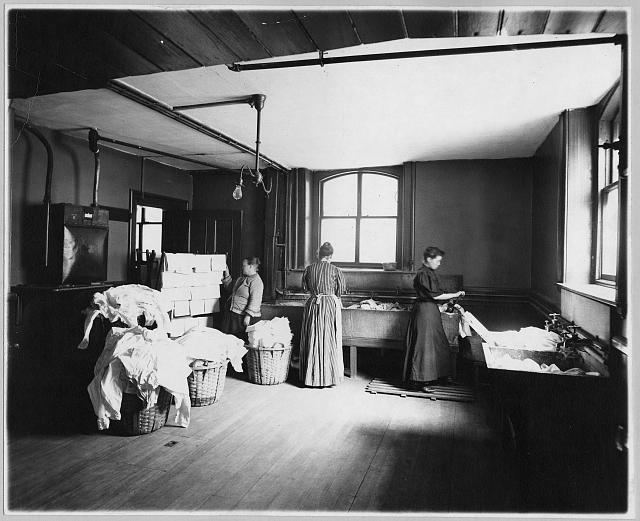
Women at work in a laundry circa 1905. Image courtesy the Library of Congress.

In July of 1890, the New York Times reported:

As woman…is now being educated to take a more active part in all branches of employment, and as she has tasted the pleasures of independence...one is forced to conclude that woman’s position in industry is secure and will be permanent. Every occupation, except those calling for too much out-door exposure or too much muscular labor, is open to woman, and if she has not already secured a footing therein the next census will show that she has found a way.

Like their contemporary counterparts, working moms in 19th century New York often struggled to find childcare. Many would drop children off at day nurseries (now more commonly known as day care centers), which were usually connected to larger religious charitable institutions. These nurseries cared for thousands of children, often for little or no cost, but their services came with strings attached in the form of religious and cultural indoctrination that often contradicted the family’s own practices.


A New York woman and her daughters making garters at home in 1908.
Image courtesy the Library of Congress.

In addition to the challenge of finding child care, working women also faced low wages, long hours and major social stigmas. Many chose to conceal the fact they worked, or led others to believe that their work was a hobby rather than a necessity. Piecework—small manufacturing jobs done by hand—allowed women to work at home, giving them the option to keep their money-making endeavors private and eliminating the need for child care. In fact, many children helped their mothers with this work to support the household.

Cultural attitudes about women in the workplace changed rapidly--and dramatically--as the 20th century progressed. According to a 2009 study, women are now the primary earners in two thirds of American families. Mainstream culture no longer stigmatizes mothers for working outside the home, but employment and parenthood continue to pull working women in opposite directions. Despite our advances, Nathalie, Jenny and their contemporaries might find this struggle very familiar!

Happy Mother's Day to all moms--whatever their work may be!

--Posted by Kira Garcia and Marianne De Padua

Tuesday, May 3, 2011

Keeping Kosher Circa 1914

Tenement Museum Educator Sarah Lohman has a passion for history and food. Through her blog, "Four Pounds Flour," she explores early American cuisine. Recently, Sarah wrote about her experience with keeping Kosher, the practice of adhering to traditional Jewish dietary laws about what can be eaten and how food should be prepared. For her project, Sarah followed recipes from meals served in 1914 at Ellis Island. Below is her first story. To read the complete series, visit Four Pounds Flour.

I work three days a week at the Lower East Side Tenement Museum as an educator. I guide visitors through tiny, dark apartments. Small spaces that 100 years ago housed families of eight or more.

Standing in the kitchen (the one with no running water, no refrigeration, and limited storage space), someone always asks with a sense of awe: “How did they do it?”

The Levine family's kitchen at 97 Orchard Street


Not just how did they raise a family, do the laundry, run a business or the myriad of tasks that took up a tenement dweller’s day. What they’re really asking is “How did they keep Kosher?” How did the millions of Jewish immigrants that poured into the Lower East Side around the turn of the century manage to preserve the traditions of their faith in the airless kitchens of a five floor walk up?

“I have no idea,” I answer. “But I’m going to find out.”

This week, I’m following kashruth. In my four floor walk up in Queens; in my modern kitchen; and only for three days. A drop in the bucket compared to the daily ins and outs of the Jewish housewife 100 years ago (or the contemporary Orthodox housewife in Williamsburg, Brooklyn).

The menu I’ll be following is a 1914 daily menu from the Kosher Kitchen at Ellis Island. I came across the menu in Jane Ziegelman’s book 97 Orchard, but the original can be found in the Ellis Island Archives. The Kosher Kitchen was opened in 1911 after advocacy by the Jewish aid organization HIAS. Imagine spending eighteen days on a steamship from Russia, where you may or may not have been provided with Kosher food, or may have had to prepare it yourself. You arrive in America to another plate of unkosher food. Exhausted, malnourished, and vulnerable to disease, you were at risk for deportation on medical grounds. The Kosher Kitchen, free to immigrants beings detained at Ellis Island, was a huge step.


Sarah's dishes and utensils designated for meat or dairy

Why is kosher kept? The basis of kosher is derived from Exodus 23:19: “Thou shalt not boil a kid in it mother’s milk.” Meat and dairy must never come together. Everything else is referred to as “parve,” and can be eaten with with meat or dairy. Utensils and dishes must be kept separate for each, as well as dish rags, cutting boards, etc. If one touches the other, the utensils are “traif”, meaning they can’t be used for either. There are laws regarding how long you must wait to eat dairy after meat (anywhere from 4-12 hours depending on your rabbi) and vice versa. There are laws regarding what animals you can eat and what cuts of meat: chickens, cows, fishes. No rabbits. No Shellfish. They must be slaughtered in a certain way and all the blood must be drained before consumption.

100 years ago, Jewish immigrants were divided into two categories: those attempting to preserve their traditions in America, and “Oyster Eaters,” those becoming more liberal and more “American” in their observances.

There’s more to it than that. Nuances and laws I’ll cover over the next few days (or you can brush up at jewfaq).

As the daughter of a Catholic, I viewed kosher like a Catholic would: this is a thing you do and if you don’t do it, you’ll burn in hell. Not so. As my colleague Judy explained it: “This is the thing you do to show your are different than your neighbors. It’s the thing you do to show you are Jewish.”

So for the next three days, my dairy will not touch my meat.


Monday, May 2, 2011

Guess the Artifact: And the Object is...

On Friday, we asked you to identify the object with the black handle in this picture...


Some of you guessed correctly, and some got very close! The object is a tracing wheel, which is used to transfer pattern markings onto fabric before it's cut for sewing garments. As some of you also pointed out, the wire contraption next to it is a hoop skirt frame, or a crinoline cage. Fabric was attached to these wire circles to create the large bell-shaped skirts popular in the 19th Century.