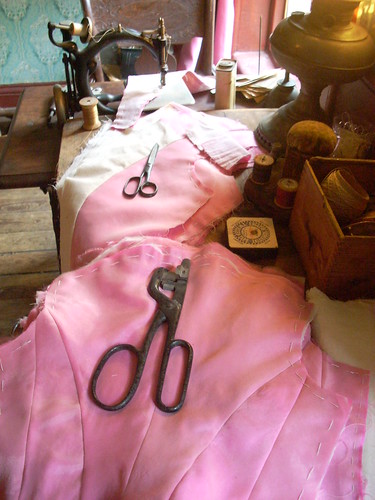
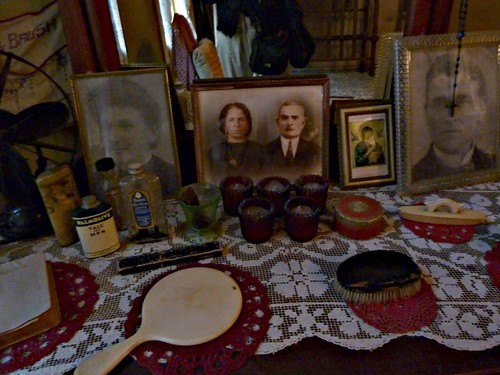
Recently, I had the opportunity to talk with two of the Tenement Museum's educators, Justin Gilman and Rachel Serkin. They told me about their jobs, inside and outside of 97 Orchard.
How long have you been working at the Tenement Museum?
JG: I've been working here for a month a half.
RS: I've been working here for four years now.
JG: Pretty different.
RS: For your fifth year, you get a chamber pot.
JG: I can't wait!
Can you tell me about your day-to-day schedule?
JG: Basically, I give tours here. I mostly do the
Moore family tour, the Irish immigrant family. I'm learning the
Piecing It Together tour starting today. I'm learning it because I took Rachel's tour and she was really great.
On a typical day, I get here about fifteen minutes before the tour and hang out with the other awesome educators. There's so many new people to meet every day. The tours last about an hour, and each and every tour is completely different. So every day is a totally different experience with student groups or families that came from Ireland or people who have no idea of Irish culture at all. I work twice a week: Thursdays and Saturdays for about five or six hours a day.
RS: When I started out at the museum, I was an access intern four summers ago in the office [
editor's note: "access" involves working to make the museum accessible to people with disabilities]. So part of my training experience was to give tours, and I loved it so much that I asked them, "Can I come back next summer?" I've stuck around ever since.
I've succeeded in doing all the building tours so I've got all the family stories. I just passed the test to do the
Immigrant Soles walking tour, and in addition, I do the
Shared Journeys program with ESL classes. I'm a teacher by profession so, for me, it's a combination of teaching/storytelling/performance art.
I typically work three days a week. My day starts at ten or eleven o'clock but I usually end up coming an hour early because I like everyone here so much. It's really fun to schmooze in our break room. It's like our warm-up for the day and then, typically, I'm doing anywhere from three to five tours a day.
I had my first school group of the year yesterday... eighth graders. I just finished graduate school and the tenement building is my unorthodox classroom.
Justin, what other experience do you bring to the Tenement Museum? Do you have another outside job?
JG: Yeah, I got a couple of jobs. I'm an actor by trade. I just graduated from Columbia in May with a master's in acting. I don't have a teaching credential so I end up teaching acting because you don't always need a credential for that in university situations. They're just like, "Aw if you can do it, come on in." That's really fun and I love it. I'm also a nanny for a five month old baby boy, a four year old, and a six year old boy and an usher in an interactive bus tour that goes through Times Square called "The Ride."
When did you start doing that?
JG: I started doing that a week ago. I had a teaching job over the summer at
Columbia where I taught high school kids acting, directing, and playwriting. Then I thought, I'm out of grad school and I have no job experience in New York City at all except for teaching. So I spent all of September trying to find work and now finally, as of five days ago, can pay my rent.
RS: Mazel tov!
So being a tour guide is brand new to you.
JG: Yeah. Everything that's happening to me right now is new but I think that all of my acting training comes into it, like breathing so you can be relaxed. I'm more of a storyteller so my tours are very, very story heavy. They're about being as dramatic as possible.
What do you each find most rewarding about being educators here?
RS: I love my job. This is the coolest job that I've ever had. And the building itself is cool, too. As Justin said, we're really storytellers. I'm from Brooklyn, born and raised, so this is my history and my family's history. I love interacting with people from all over the world. Sometimes you touch people. I've had grown men get teary-eyed on my tours. And people share their stories. These families came to this country a hundred years ago and I try to get people to realize you have more in common with them than you might think.
JG: For me, it's the people as well. Teaching people is huge for me. And since I'm doing the Irish tour mostly, seeing people share what their ancestors had to deal with when they came to New York, it's really striking to me how that affects people. It gets me thinking too, because I'm half Irish, about my family, and thinking about what they had to deal with when they came to New York. I'm so lucky and so grateful that they dealt with that so we don't have to.
But the most rewarding thing is this job makes me feel like more of an activist because there's a lot we still have to do, especially in the Lower East Side, revving people up and saying, "we're not done yet." It's what helps me wake up in the morning.
RS: A lot of people sometimes come in with the mindset that their family was the only demographic to come through, and I love talking about
Kleindeutschland (Little Germany) or the Five Points or Chinatown. This neighborhood is still a living, breathing thing. This community is still a living organism, still here.
What's most difficult about your job?
RS: Oh boy.
JG: I'm new to this, so I don't have a lot of difficulties right now. It's the simple things like remembering the dates, the names, the information, and being okay with not knowing the answers to everything. I'd like to be a know-it-all and make something up while saying it passionately but I can't do that because the visitors might know more than me. It's the idea of humbly giving a tour. I am not the end-all, be-all of this information. You clearly might know more than me and I'd love to hear your experience. The other thing is that people come in with their story and their family and sometimes it's difficult to open up their minds and say, "that's your experience, but we're talking about the Moore family. It's a different experience, but there may be correlations." It can be difficult, but when it happens, it's really rewarding.
RS: And if you work at a job like this, you learn a lot about human behavior and people. When there's fifteen, sixteen of us and 325 square feet, a lot of stuff can go down on a hot summer day, and sometimes people don't necessarily want to hear what you want to say. But we like to be challenged, and we like when people challenge each other. The majority of the time, the discussions are wonderful, but sometimes people just come in with a certain mindset and they aren't willing to change. They might not see any value in the history of the building, which is unfortunate.
One of the most challenging things for me is that I talk so much. We talk for a living, and it can be emotionally exhausting sometimes. When I was learning these tours, like the Moores tour, I started having dreams that I was giving the tour in my sleep.
Doing every tour here, you must be juggling a lot of information.
RS: It's amazing. I've learned that you can just turn it on for each tour. Sometimes you feel like you're telling the same tour but in the end, you can still bring it back to suit the individual theme or topic of the tour.
Do you ever confuse one tour for another?
RS: Oh yeah. One time I was doing a
Getting By tour and I forgot Julius Gumpertz's name. I just drew a blank.
JG: That's something that I'm nervous about now that I'm learning my second tour. I've just been giving this one tour every day, and suddenly there's a lot of new information.
How do you prepare for all the question that you're asked?
RS: I'm used to some of them. "Is this the fireplace? Where's the toilet?" We get a lot of some of the same questions but I love it when visitors ask questions. I don't feel that I've done my job right when they're quiet. This is your tour. I like to talk, but I don't like to lecture. I want you to share. Open it up, ask anything you want.
JG: And we have tour content for every tour, and it's
so much information that you couldn't possibly get out in an hour. So sometimes it's good for me to go back and reread the tour content because there's so much info that answers questions I have for myself. We have to study a lot because we're students at the same time as we're educators.
RS: We're always observing each other. They put us on observations because it's the same content, but every educator has a different way of spinning the same story. It refreshes your tour content.
JG: I observed somebody else today on the Moore family tour, and she does a tour that is 180 degrees from what I do, but in the end, there's the same result, and it's beautiful to see that.
How do you react when you don't know something? Do you admit that you just don't know it and need to study?
JG: I have to because I feel like otherwise I'm not doing my job. I always say "please go to the Visitor's Center where we have so many books and online access for further research." If I honestly just don't the information, it's always better for me to say that than lie to you.
RS: Absolutely. There's some things I just don't know and I'll say "Sorry, but I'm going to be sure to get that information."
Do people typically react well when that happens?
RS: Yeah. Overall, people are very understanding. We don't know everything and that's okay.
JG: I think that's how I feel a leader should work. It's like I know something up to a point and then I may need your help. Because I think when we lie and give the wrong information, then we're sending them the wrong message about our position. And I'd rather just say, "if you know more than me, you might want to talk about this because I want to hear." It's not like I'm the dictator and they're my minions. We're all in this together and I just happen to know more about this particular family.
RS: I've had visitors step in and save me because they knew an answer I didn't. Thank you!
JG: When there's somebody who has come straight from Ireland because they've heard about this museum and they want to take this tour, I'll always look to them and ask if they want to elaborate on anything. I don't want to feel like I know more than them because if his or her family dealt directly with these issues, then technically I don't.
Are there any particularly odd or unique questions that you recall getting?
RS: I've had visitors obsess with the families about birth control and things like that. I have people all the time asking, about the Baldizzis, "So they're Italian Catholics and they really only had two kids? Can you explain that?"
JG: I got asked the question, "Why are you talking about the Irish people so much? When are you going to talk about the Jews?" and I had to say "I'm sorry ma'am, I think you're on the wrong tour?" I can't give all of the tours at once. It's impossible.
I also get a little political with my tour, and we talk about the "No Irish Need Apply" policy, when many people didn't want the Irish to hold jobs. I relate that to modern times, trying to understand who might be in the position of the Irish today. I mention the Arizona immigration law, and sometimes I'll encounter people from Arizona. One woman stood up and gave a speech about why the law was fantastic, but I loved it. I love that stuff because I'd never heard someone vocalize that side of the issue before. People can get super passionate and they've experienced things that I'll never know.
Have you been in situations where you've applied the experience you've gained here?
RS: I come from the belief that history and literature really compliment each other. You look at our bookshop and you've got some of the greatest works of literature. I'd want to teach my kids Jacob Riis's
How the Other Half Lives, excerpts from
Triangle: The Fire That Changed America, the work of
Abraham Cahan, the editor of
The Forward, and
Isaac Bashevis Singer. Some of the greatest works of literature come out of this time, so I love when I get school kids and tell them it's not just for your history class. Literature is a product of a time period and a historical event. That's exciting for me.
I was doing my student teaching last year, and I was a little nervous because the kids who come to this museum are kind of my guinea pigs. We had a workshop last week about classroom management and the school kids who are coming back. Essentially, we are playing the roles of teachers. We don't see these kids after two hours but we want them to have a positive educational experience. I'm applying for a teaching job right now so I love that I can still apply these skills I've learned and use them somewhere. And I feel so gratified when I get through to a group of kids.
Justin, has it helped you as a performer?
JG: Yeah, for sure. It's taught me more clearly how to read a room. Just like with an audience on stage, when you're giving a tour, sometimes you'll see that there's a gloomy atmosphere going on, and the tour that I give is already specifically gloomy so I can make the decision to put more jokes in, to have a better time. We don't need to be miserable while dealing with sad subject matter.
I use that at my usher job in Times Square job as well, thinking about what these people need and how I can help them. How can I play with a person for an hour and be okay with things changing so that they can have a good experience? I don't have to force gloom and doom on them if I can tell they already feel that way.
And It's the same way on stage. If the audience isn't feeling it, okay, let's do it funny.
RS: You've got to improvise. For me, with school kids, eighth through twelfth graders are the toughest sell because they're at that age where it's hardest to engage and motivate them. They come and pretend they don't care about history but they really do. And I have so much fun really trying to challenge them. I've also become a much better listener as a result of working here, hearing so many other people. It's not all about us talking. Even the questions I ask are a skill. We have some great facilitators that really know how to challenge visitors and ask these open-ended questions. It's a difficult skill and a great skill to have.
JG: It's taught me to be more open and inviting. I want you to be able to open up to me. It's the same on stage, where even if I'm playing a villain, I have to play an inviting villain because I want you to come on the journey with me. I don't want to keep you at bay. The greatest villain performances are when you want to be that guy's friend even though he's a maniac.
Do you think that willingness to learn is contagious with the visitors to the museum?
JG: Absolutely.
RS: We're accessible. We're the face of the museum. We're approachable. I love talking about how I'm the girl from Brooklyn. My mom's from Brooklyn, my dad's from the Bronx, and people can relate to those kind of stories. We're all the children of immigrants.
- Posted by Joe Klarl