Tuesday, November 10, 2009

Questions for Curatorial: The Significance of Bridges

Curatorial Director Dave answers your questions.

How did the construction of the Brooklyn Bridge affect people living on the Lower East Side?
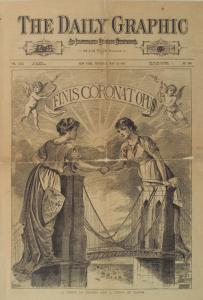
A union of hearts and a union ... Digital ID: PS_LHG_CD22_69. New York Public Library

The Brooklyn Bridge opened on May 24, 1883, instantly becoming the longest bridge in the world. As the first bridge connecting the cities of Brooklyn and New York (Manhattan), it offered a cheap alternative to the ferries that daily carried men back and forth between their homes and workplaces. It was also built largely by immigrant workers, many of whom lived on the Lower East Side.

When the Brooklyn Elevated to Fulton Ferry was completed in 1885, providing easy access to the interior of Brooklyn, traffic on the Bridge more than doubled, so that by 1885 it was handling some 20 million passengers a year.

For this reason, it undoubtedly aided the exodus of those immigrants and children of immigrants able to afford homes in Brooklyn and the daily commute by street car into the city. While the dispersal of the Lower East Side’s German and Irish immigrant communities was already well underway, the opening the Brooklyn bridge likely hastened their exodus.

But 25 years after it opened, the Lower East Side reached its peak population density.

Built in 1903, the Williamsburg Bridge had a greater effect on the ability of immigrants to leave the Lower East Side. In the early 20th century, the bridge was seen as a passageway to a new life in Williamsburg, Brooklyn by thousands of Jewish immigrants fleeing the overcrowded neighborhood.

Even more important was the inauguration of the subway in 1904, whose extension over the next several decades allowed for the further decentralization of the city by making rapid transportation accessible to the working-class New Yorker. Once subway lines had been extended to places like Brownsville and East New York in Brooklyn, these areas became second Lower East Sides — immigrant neighborhoods that provided homes, workplaces, and communities to thousands of new Americans.
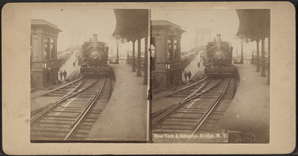
New York and Brooklyn Bridge, ... Digital ID: G91F173_013F. New York Public Library

(Images courtesy New York Public Library - United States in Stereo: In the Robert N. Dennis Collection of Stereoscopic Views; and United States History, Local History and Genealogy Division.)

Monday, November 9, 2009

Tricks, Treats and Ghosts

Children often come into the museum’s slightly spooky, dark hallway and ask in fear, “Are there ghosts at 97 Orchard Street?” We say, “No.”

But this October 31, the Museum opened its doors for a special Family Halloween Celebration, and some unexpected specters were spotted in the halls.

The day began with cider and donuts, arts-and-crafts projects and a photo booth for vintage family photos. Large spotted spiders, cobwebs, and black crepe paper streamers turned the basement into a spooky party space.

Once guests were invited upstairs, they saw faces both old and new - Victoria Confino, part of the Confino Family Living History Tour, was busying about her kitchen as usual, but Harris Levine, Bridget Moore, and Rosaria and Adolfo Baldizzi were also at home this special morning.

All of our ghosts (In reality, costumed interpreters, of course) made charming hosts.

Victoria pointed out that our clothes looked pretty strange to her 1916 eyes: T-shirts and trousers on women seemed as peculiar as a young trick-or-treater dressed as a ballerina –

“You’re wearing your underwear on the outside?” Victoria asked about the tutu and tights. “Is that the custom where you come from?”

Bridget Moore, a tenant in 1869, was concerned that she couldn’t offer us tea. Harris Levine (who believed it was 1897) invited the 11-year-olds visiting his apartment to work full-time in his garment factory.

"Only ten hours a day - you can have the Sabbath off!"

Rosaria Baldizzi insisted that we call her Sadie.

“I have an American name now,” she explained.

She was packing and lamented the tenants’ recent eviction from the building after the new (1934) law requiring landlords to fireproof staircases in all tenements. The building, she reminded us, had been her home for many years. Her husband, Adolfo, mentioned their move too but was looking forward to the change.

For those of us who gives tours of the building, meeting this cast of characters in the flesh was unexpectedly moving. Even though those apparitions were just our coworkers in period costumes, they were a reminder that the stories we tell are true ones, that people really did live at 97 Orchard, and that their lives were as varied as any across this great city.

-- Posted by Judy Levin

Friday, November 6, 2009

Artifacts found in 97 Orchard Street's basement

Here is a follow-up to Wednesday's post about work in the basement of 97 Orchard Street. Our collections manager Derya describes what she found.


I think this research brings up an interesting question that many museums, over our history, have dealt with - how do you determine what is valuable and what is not? What kind of things should have protection and care in a museum's collection? Some folks might look at these bits of paper and plastic and wonder why we're bothering to save them. Do you think they have any value? What sort of objects do you think museums should be collecting?

- posted by kate

Thursday, November 5, 2009

The Snakehead - Tenement Talk Review

Patrick Radden Keefe was studying for the bar exam in the summer of 2005 when he first heard about Sister Ping, a woman whose story had captivated many in the legal community.  On the surface, she seemed fairly ordinary: an immigrant from the Fujian province of China who ran a small convenience store on Hester Street.  But there was another Sister Ping – the savvy and well-connected entrepreneur who ran an unprecedented human trafficking operation, bringing thousands of Fujianese to New York in the 1980s and ‘90s.  

She was a snakehead an “immigration broker” who smuggled people from one country to another.  It is estimated that she made approximately $40 million in her ingenious—albeit dangerous and illicit—scheme.  But in the summer of 2005, Sister Ping’s actions were finally met with retribution when she was convicted and sentenced to 35 years (likely the rest of her life) in prison.

Keefe details Sister Ping’s incredible narrative in his new book, The Snakehead: An Epic Tale of the Chinatown Underworld and the American Dream.  Speaking at a Tenement Talk on October 27th, the author noted that the museum was the “perfect place” to discuss Sister Ping’s story, an odd permutation of the American dream that reveals “a chapter in immigration history” that may be unfamiliar to many.

Born in China during the Great Leap Forward, Sister Ping came of age during the Cultural Revolution and was no stranger to hardship.  Upon moving to New York, she quickly became known in the Fujianese community as “a person who moves people.”  What started as a small endeavor turned into a huge underground business, complete with ties to violent gangs who assisted in her operation.  By the early 1990s, Sister Ping was charging $35,000 per person for passage from China to the US by boat. 

One such ship, the ill-fated Golden Venture, ran aground off Queens on June 6, 1993, after an arduous 120 days at sea with 300 Fujianese in its hull.  When the dust settled, ten passengers were dead, the rest were detained, and Sister Ping was indicted for her involvement.  Shortly after, she fled the country, leaving a wake of controversy with some unlikely players and leading to an FBI investigation that ended in her eventual apprehension in Hong Kong in 2000.

Keefe spoke to the audience about his research process, which included hundreds of interviews with many of those involved, including Sister Ping’s gang associates, law enforcement officials, and Golden Venture passengers and their lawyers.  Upon traveling to China to speak with her friends and family, he found that Sister Ping is regarded in high esteem there, as a sort of “latter-day Harriet Tubman.”  Fujianese immigrants in Chinatown echoed those positive sentiments, holding her to a “Robin Hood” status. 

When asked about his own feelings towards Sister Ping, Keefe was not quite as forgiving.  “Robin Hood wasn’t in it for the money,” he said.  He did note, however, that she was a brilliant business woman with a knack for seeing a need and filling it, not unlike many other successful immigrants have in the past.  And there is little doubt that other snakeheads have now filled the void left by Sister Ping.  While there is no accurate data on the number of people currently leaving the Fujian province for the US, it is estimated that there has been a five-fold increase in undocumented Chinese immigration since the 2008 recession hit.   

Sister Ping’s story may be unique, but it is tied to this larger theme, which is why Keefe’s book is a definite must-read for anyone interested in immigration issues in the US.

For the fascinating account of Sister Ping’s story, check out Patrick Radden Keefe’s The Snakehead: An Epic Tale of the Chinatown Underworld and the American Dream, available online or at the Tenement Museum Shop at 108 Orchard Street.

- Posted by Kristin Shiller, Orchard Street Contemporaries volunteer. 

The Orchard Street Contemporaries is a group of young professionals committed to advancing the mission of the Tenement Museum by connecting the immigrant history of the LES to the vibrancy of the neighborhood today through social events, networking and museum programming. 

The group provides a forum for exploration of our nation’s immigrant heritage, and what that means for us now.  For more info, fan the OSC on Facebook or join the mailing list by emailing osc@tenement.org.

Wednesday, November 4, 2009

Urban Archeology at the Tenement Museum

No one ever said museum work was glamorous. Here's Derya, the Museum's collections manager, discussing her work in the basement of 97 Orchard Street.


Tomorrow or Friday we'll share what small treasures she's discovered...

Tuesday, November 3, 2009

Work has begun on our Storefronts exhibit!

In addition to starting work on the rear yard exhibit, we have also begun serious work on Schneider's Saloon, which has long been in the planning and research stages. If you subscribe to our newsletter, you may have read about this exhibit already.

In 97 Orchard Street's basement, from 1864 until the late 1880s, John Schneider ran a lager bier saloon. This was a place for food and drink but also socialization, political discussions, and families to spend time together. We'll be reconstructing the saloon but also discussing some of the other businesses that were once housed in 97 Orchard, including a butcher shop and auction house.

Earlier in the summer, Jablonski Building Conservation completed some architectural probes in the basement. Now we've dived in even more, removing large sections of sheetrock on the walls to see what we can find underneath. The existing historical fabric is largely intact from decades earlier. Even seemingly insignificant information (like whether a column is painted all the way around or whether there is decorative woodwork on the ceiling) can tell us how the space was used at different times in history.

We found evidence of wallpaper in the north-rear room, which is used for storage (see Chris and Bob at work in the slideshow below). This is significant because it suggests that there were rear apartments in the basement space, something the Museum had suspected but never confirmed with physical evidence. In the late 19th century, wallpaper was largely identified with residential spaces, not commercial.

In all likelihood, there were two apartments in the rear and a large storefront up front, which in the mid-19th century would have been the saloon. The Schnieders may well have lived in back. Sometime in the 1890s, it seems the storefront space was subdivided into two, but the apartments probably remained for a bit longer, and the storekeeps may still have lived in back of the store. Eventually they were cleared out completely and both sides of the basement were turned over to storefronts.

Here are some photos from the space. Later this week, I'll post more on the work.


- Posted by Kate

Monday, November 2, 2009

Work has begun on Rear Yard exhibit!

This week we started construction on the rear yard.


If you ever walked by in the past, or took The Moores: An Irish Family in America tour, you probably remember that the yard looked something like this:


The flagstones (stacked up around the edge) were removed from the yard. The large pieces of stone are architectural details from the old Daily Forward building, which the Museum salvaged when the building was being renovated into condos.

While the stone details will be put into storage, we're planning to use the flagstones in the restoration. We're building the wooden privy shed against that cinder block wall, installing a water pump next to that, and putting up a wooden fence around the yard, similar to what you see here:


This is Fanny Rogarshevsky and her son Sam in 97 Orchard Street's rear yard, early 20th century, but date unknown.


Here's what we plan for the final exhibit to look like:


The water pump is there on the left. Until well into the 20th century, there was a row of tenements up against ours on what is now the sidewalk and northbound traffic lane of Allen Street, so this image really does give a good sense of what our yard probably looked like circa 1904, when this photo was taken. (Courtesy New York Public Library, original source New York City Tenement House Department).

Here are some more photos from the NYPL to give you a better sense of what the privy shed will look like. (Warning, I'm sending you down a time-suck rabbit hole if you like looking at old pictures from the Tenement House Department - they're pretty interesting, and there are lots of them in the NYPL's collection.)

There will also be laundry lines and wash buckets to simulate the activity that would have constantly been going on in this space (for years, the only source of water for the building was the rear yard water pump, and the only toilets were back here, so you can imagine how many people would have been in and out all day long).

The restoration will be semi-visible from the street and will enhance The Moores tour by giving some context to the discussion about health and sanitation in tenement housing. For now, there are no plans for it to be its own free-standing tour or exhibit.

We'll keep you posted as work continues. We should be done in a few weeks!

- Posted by Kate