Thursday, September 30, 2010

Tenement Talks: The Man Who Never Returned

Courtesy of Indiebound.org
Anybody who loves a good mystery is going to want to join us tonight at Tenement Talks when novelist Peter Quinn discusses his new book, The Man Who Never Returned, alongside journalist and author Kevin Baker.

When Joseph Force Crater, a powerful Justice on the Supreme Court, suddenly vanished after dinner in the summer of 1930, the country was shocked as his disappearance made headlines. A grand jury investigation of the case was launched amidst swirling rumors about Crater's whereabouts, but with not much to go on, no conclusions were ever reached. Urban legends flourished as Carter's disappearance from W. 45th Street grew to be one of the biggest mysteries in New York City history.

Peter Quinn's novel revisits this bizarre story through the eyes of fictional detective Fintan Dunne, who comes out of retirement in 1955 determined to unearth what happened nearly three decades earlier. Dunne, who was introduced in Quinn's earlier book Hour of the Cat, faces nearly insurmountable odds while chasing the truth, as he answers to a greedy newspaper bigwig hungry for a story and confronts the case's perplexing, troubled history.

Quinn, who once worked as a speechwriter for governors Hugh Carey and Mario Cuomo, seamlessly blends the city's history with the fictional schemes and theories of his hardheaded protagonist. Best-selling author James Patterson says Quinn "is perfecting, if not actually creating, a genre you could call the history-mystery. The Man Who Never Returned is a dazzling story."

And as those of you who have seen Quinn at previous Tenement Talks know, he is a consummate speaker, witty and interesting as they come. 

So join Kevin Baker, contributing editor of Harper's Magazine and contributing writer of The New York Times, on September 30 at 6:30 pm to discuss a story he believes "you may never want to leave." The conversation begins at 108 Orchard Street at Delancey, and you can RSVP here.

- Posted by Joe Klarl

Wednesday, September 29, 2010

Tuesday, September 28, 2010

Did You Know That...

A palm reader once lived at 97 Orchard Street. During restoration work, a business card advertising "Professor Dora Meltzer" as a palm reader in both Yiddish and English was discovered beneath the floorboards. By the turn of the century she would have been one of many selling fortunes to women within the Lower East Side's Jewish immigrant community.
Collection of the Lower East Side Tenement Museum.
Found in 1993 at 97 Orchard Street.
Wrongly assumed by outsiders to be criminals, palm readers or fortunetellers were more likely traditional housewives, though not necessarily reputable businesswomen. Common tricks, including searching through visitors' belongings, were frequently employed to gather information.

Such behavior might seem devious, but fortune telling helped liberate otherwise housebound immigrant women like Dora Meltzer from the isolation of the tenement, allowing them to participate in the local economy and interact with the outside world. America was an unfamiliar place, especially for Jewish immigrant women. Fortunetellers could offer customers advice about adapting to their new home or, even better, reveal the future and prepare them for what life in America held.

In 1911, however, New York State Assembly outlawed fortune telling, or even advertising it, for money. Although it remains illegal to accept money for forecasting the future today, fortune telling is still widely practiced throughout the five boroughs of New York City.

Monday, September 27, 2010

He Who Does Not Love Wine...

Curator of Furnishings Pamela Keech has been working hard to develop plans for our new exhibit on 97 Orchard's businesses, opening next year. Our team has done extensive research about the businesses, and the families who ran them, and Pamela is sourcing artifacts and furniture that will re-create the basement storefronts and apartments back to a specific place in time. You've already seen her handiwork in each of the Museum's restored apartments. Here she reports on one of the new artifacts she's found for Schneider's Saloon, circa 1870s:

I recently purchased a stoneware pitcher for the exhibit on Ebay. It has an inscription on the collar that says (in German): "Wer nicht liebt Wein Weib und Gesang Bleibt Ein Narr sein Lebenlang". This translates to, "He who does not love wine, women, and song will be a fool his whole life long.” The saying is variously attributed to Johann Heinrich Voss (1751-1826) and to Martin Luther (1483-1546).

The print below was published in 1873 and demonstrates the popularity of the saying at the time the Schneider family was operating the saloon. This is why history is so much fun.

Friday, September 24, 2010

Visitors of the Week: Paulette Kaufman and Nancy Leonard

From left: Paulette and Nancy
Each week, we profile one of the many interesting visitors who stop by the Tenement Museum. Do you want to be our next Visitor of the Week? If you're planning to visit and would like to be interviewed, send us an email.

Meet Paulette Kaufmann and Nancy Leonard, friends who decided to take the Piecing It Together tour, visiting the homes of Jewish immigrants, the Levines and Rogarshevskys. Kaufmann, a New York native, had visited many years ago with her husband and described it as "such an enriching experience" that she was glad to return when Leonard decided to take a tour.

I was lucky enough to speak to them about the harshness of early immigrant life and why New York tourists ought to head over to the Tenement Museum.

When you first walked into the apartments you saw today, what was your immediate reaction?
PK: Small spaces. I was beginning to wonder how they survived.

And what did you learn about the immigrants who lived there?
PK: For me, it was a repeat so actually, I can remember more of the experience because I've come back a second time. I do a lot of historical research and I was doing some research on an immigrant who lived in the northern part of Manhattan. So I was remembering back to my experience here. I was looking at the severance records and I was looking at the other information that I had about him and I kept referencing back to the time I had been here so it's always nice to be able to come back and take a look again, now with that experience.

If you could ask an immigrant at that time any one question, what would it be?
NL: I think the obvious one from a historical perspective is "how did you survive?" because it just seems like a very difficult life, a lot of physical labor, and you sort of understand why people didn't live as long as we tend to live now. But I think more about the community, what it was like to grow up there, whether they went to school or not would be fascinating to know, and what they learned from it all.

Would you encourage others to visit the Tenement Museum?
PK: Oh, absolutely. As a tourist, you may think it's all about Rockefeller Center, but the city has great, great stories to tell on every corner and in every burrough. I've traveled all around the world, and I'm always interested when I'm going into "old" cities or older areas of cities. I want to know how people lived their lives or the change that was going on, so on and so forth. So I encourage anybody visiting New York to come down here and see a slice of the city that they probably didn't know about.

- Interview by Joe Klarl

Thursday, September 23, 2010

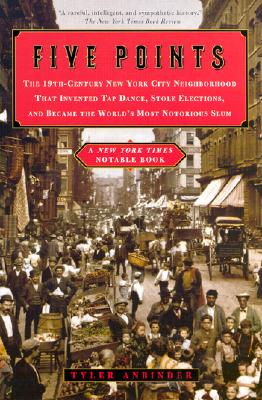
Tenement Talks: Five Points

Courtesy of Indiebound.org
Ever wonder about the Lower East Side's seedy history? Make sure to join us tonight at Tenement Talks as we're thrilled to host Tyler Anbinder, historian and author of Five Points: The 19th-Century New York City Neighborhood That Invented Tap Dance, Stole Elections, and Became the World's Most Notorious Slum.

A lovingly thorough history of one of the most vibrant, corrupt, and bustling neighborhoods ever, Five Points was groundbreaking upon release and introduced many readers to a place few knew even existed. The New York Daily News proclaimed that Anbinder "so thoroughly re-created Five Points that the stench of life there all but rises from the pages."

In Five Points, the author painstakingly recreates the lives of those who lived in modern-day Chinatown, predominantly impoverished African Americans, Irish, Jewish, German, Jewish, and Italians who sought a better life amidst the chaos of street riots and crime.

As notable writers of the time, including Charles Dickens, wrote gruesome tales of the slums, the murderous and rollicking Five Points quickly gained a world-famous reputation. "While Americans may have considered Five Points repulsive," Anbinder notes, "they found it fascinating as well."

In his novel, Anbinder finds the truth within the incredible tales of the depraved roots of New York City and explores the regular lives of immigrants who survived and thrived there. From religion to politics and work to play, the book creates a fully immersive portrait of a neighborhood that had "more fighting, drinking, and vice than almost anywhere else; but also more dancing and nightlife, more dense networks of clubs and charities." And, of course, he also explores the end of the era and the origins of Little Italy and Chinatown.

So, whether you're a history buff or have never even heard of the incredible Five Points, a neighborhood that helped shape New York City today, remember to stop by tonight - the Museum Shop, 108 Orchard Street at Delancey -- to join us for this event. RSVP at events@tenement.org and we'll kick things off at 6:30 pm.

- Posted by Joe Klarl

Wednesday, September 22, 2010

Teens Turn the Tragedy of History into Theater

Today we have a guest-blog from Ryan Gilliam, Artistic/Executive Director, Downtown Art.

Many New Yorkers are familiar with the history of the Triangle Shirtwaist Factory fire. It was a devastating event and launched a determined and ultimately successful campaign to improve factory working conditions early in the last century.

The young workers who died in the fire, most of them women, many of them girls still in their teens, are remembered each year on the fire’s anniversary. Their names are chalked on the sidewalk outside the tenements where they once lived. This spring, on March 25, 2011, the 100th anniversary of the fire will be commemorated with a whole host of events.

I’m a playwright and theater director who has chosen to work with teens for the past twenty years. I admire young people and have long sought to be a champion for their capacities and talents. A year or so ago, I began my own journey to discover who the young seamstresses of the Triangle Factory had been before they became victims of that terrible fire. I found their story to be remarkable.

These young women, most of whom were immigrants and only a handful of whom had any experience with the labor movement, managed to sustain one of the first major strikes by women, a general strike which sought a 52 hour work week, a 20% pay increase, and union recognition.

The strike, which lasted through a cold and bitter winter, was controversial, and the girls found themselves facing intimidation and violence on the picket lines as well as harsh treatment from the police and the courts. Their plight galvanized middle and upper class women to join them on the picket line, which became front page news.

The courage and perseverance of these young women in the strike of 1909/10, often called the "Uprising of the 20,000" inspired me to write The Waistmaker’s Opera. The opera premiered last May, and the heartfelt responses from our audiences were deeply moving.

We had the pleasure of performing an excerpt of the opera last week at the Tenement Museum's Tenement Talks series, as part of a program featuring author Philip Dray, whose new book, There is Power in a Union, has just been released.

This Saturday, September 25, we will open it again for two weekends. We perform our modern rock opera (original score by Michael Hickey) with a company of fifteen teen girls and a band of teen musicians. Act 1 moves through the streets after its start at the site of the Triangle Shirtwaist Factory. Act 2 takes place in one location, a vacant lot on East 3rd Street, and the audience is seated.

To work with a company of young women the same age as the shirtwaistmakers has been a powerful experience for me. It is too easy for adults to overlook the contributions of teens to this city - to our lives, even - and The Waistmaker’s Opera is an effort to remember how young women, a hundred years ago, changed us not only with the tragedy of their deaths but with the courage of their lives.

-- Ryan Gilliam

For information on performances of The Waistmaker’s Opera, please visit our website at http://www.downtownart.org/