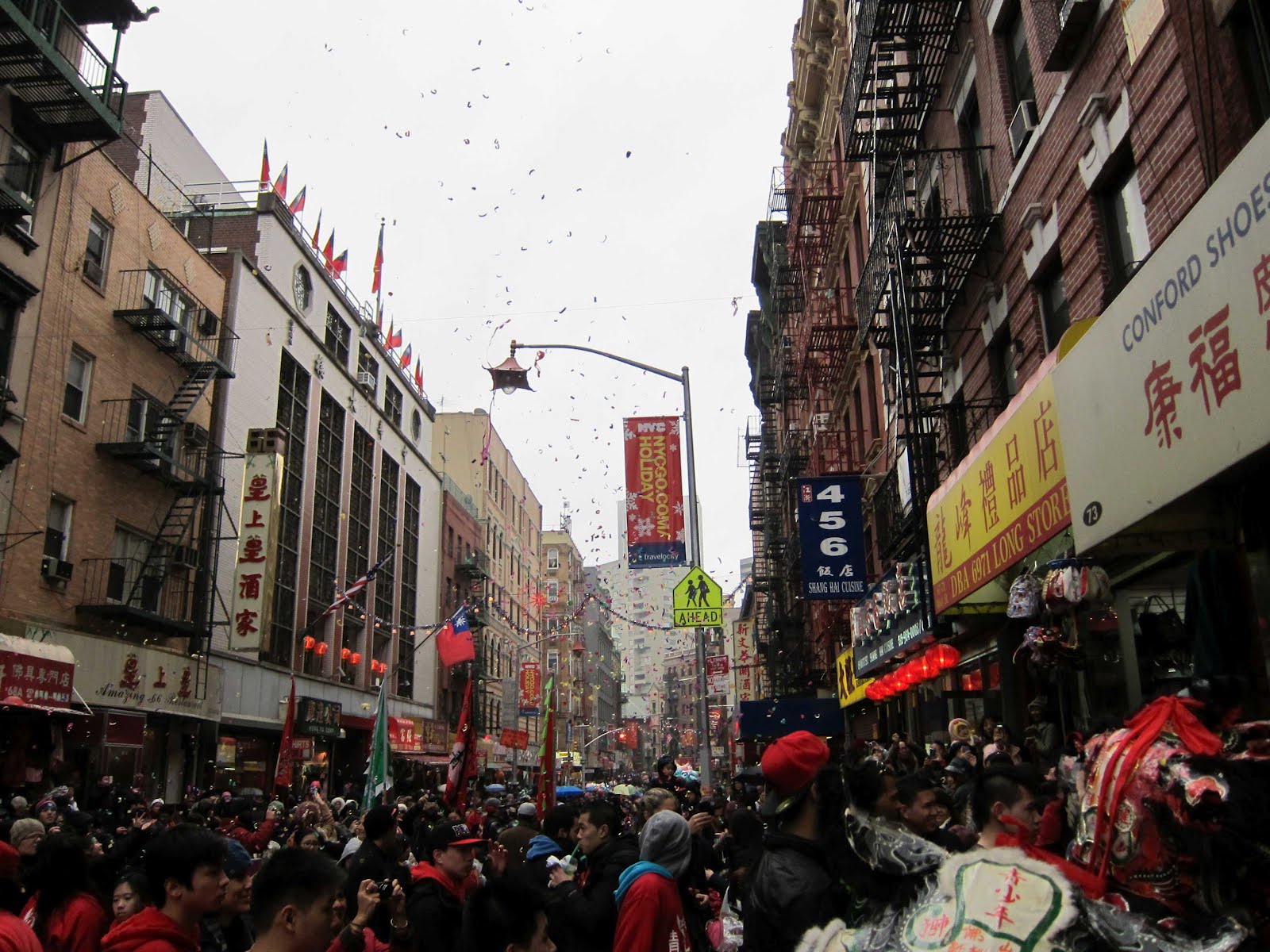
The cold wet weather didn't stop revelers from celebrating the first day of the Lunar New Year in Chinatown today. The colors and sounds of this holiday are always a welcome reprieve from the winter gloom, so we strolled over from the Lower East Side to join the party and visit our neighbors.
Kids decked out in brightly colored costumes enjoyed the excitement, clapping along to the drums and throwing confetti.
A lion dance procession made its way through the neighborhood, accompanied by drums and cymbals. The brightly colored lions (often confused with dragons) visit local shops and restaurants to bring good luck in the year to come, taking offerings of money in red envelopes from proprietors.
Happy New Year to all--may the year of the Dragon be a great one!
Showing posts with label chinatown. Show all posts
Monday, January 23, 2012
Wednesday, October 27, 2010
Tenement Talks: Chinatown Noir with Henry Chang and Ed Lin
| Courtesy of Indiebound.org |
If you've ever read hard-edged detective stories, it's difficult to imagine a better setting for them than the gritty, bustling streets of modern-day Chinatown. That's why authors Henry Chang and Ed Lin knew the perfect home in which to set their wonderfully compelling noir sagas.
Join us for tonight's Tenement Talks with Chang, author of Red Jade, and Lin, author of Snakes Can't Run, as they discuss their neighborhood's dark side.
In Red Jade, Chinatown native Chang continues his Detective Jack Yu series. This time, Yu tries to solve the grisly murder of a crime boss. As the details of the case unravel, the personal stakes build to a dangerous climax.
Last year, the author was kind enough to sign my worn-out copy of his debut, Chinatown Beat, and if Jade is even half as entertaining as the first, you won’t want to miss his appearance here.
![]() |
| Courtesy of Indiebound.org |
Lin’s Snakes Can’t Run follows his own detective protagonist, Robert Chow, as he navigates the mean streets of 1970s Chinatown during the sweltering summer. Chow must solve his newest case while confronting snakeheads, Chinatown’s murderous gang of human smugglers. The results are revelatory and the mysterious Snakes is a worthy successor to 2007’s brilliant This Is a Bust.
RSVP here to let us know you're coming; seating is first come, first serve. Anyone who'd like to buy a book from us in advance will get a reserved seat up front - call 212-431-0233 x259. Either way you're guaranteed to love these two speakers (we loved Henry Chang's 2009 Talk so much that we brought him back!)
The discussion begins at 6:30 pm at the Museum Shop, 108 Orchard Street.
- Posted by Joe Klarl
The discussion begins at 6:30 pm at the Museum Shop, 108 Orchard Street.
- Posted by Joe Klarl
Thursday, July 15, 2010
1882 Chinese Exclusion Act
The first major wave of Chinese immigrants came to the United States following the 1849 California gold rush. The vast majority of the incoming Chinese were men who worked in labor-intensive industries like railroads, mines, and canneries. Because Chinese laborers were willing to work for lower wages than their European counterparts, companies often used the Chinese as strikebreakers. Labor competition led to resentment of the Chinese and political agitation to limit the number coming into the country.

Courtesy New York Public Library, Mid-Manhattan Picture Collection.
This animosity toward the Chinese culminated in the passage of the 1882 Chinese Exclusion Act, which banned Chinese laborers from entering the United States. Under the provisions of this act, the burden of proof for entry lay on the Chinese. The law also separated “desirable” and “undesirable” immigrants by including exceptions for merchants, students, teachers, and diplomats.

Courtesy New York Public Library, Mid-Manhattan Picture Collection. This Thomas Nast illustration was published in 1870. The anti-immigrant Know Nothing Party's flag is raised on the barricade.
The Chinese Exclusion Act was the first time that the United States passed a law to bar a specific race or ethnicity from entering the country. The immigration restrictions had important consequences for the character and experience of Chinese communities in America. During the period of exclusion, women and children were a rare sight in Chinatown “bachelor societies.”

Courtesy New York Public Library, Mid-Manhattan Picture Collection. This 1882 illustration appeared in Puck magazine.
Initially, the act called for a ten-year period of exclusion, but exclusion lasted until after WWII when the 1943 Magnuson Act formally replaced exclusion with national quotas. The quota system still limited Chinese immigration to about 100 people per year so restrictions lasted in effect until the Immigration and Nationality Act of 1965.
Between 1881 and 1896, Chinese immigrants fought back by filing several lawsuits that went up to the Supreme Court. Many of these cases established precedents still used in human rights cases today.
- Special thanks to Beatrice Chen, Director of Education and Programs at the Museum of the Chinese in America, for writing this post. Visit MOCA to learn more about the Chinese immigrant experience.
Courtesy New York Public Library, Mid-Manhattan Picture Collection.
This animosity toward the Chinese culminated in the passage of the 1882 Chinese Exclusion Act, which banned Chinese laborers from entering the United States. Under the provisions of this act, the burden of proof for entry lay on the Chinese. The law also separated “desirable” and “undesirable” immigrants by including exceptions for merchants, students, teachers, and diplomats.
Courtesy New York Public Library, Mid-Manhattan Picture Collection. This Thomas Nast illustration was published in 1870. The anti-immigrant Know Nothing Party's flag is raised on the barricade.
The Chinese Exclusion Act was the first time that the United States passed a law to bar a specific race or ethnicity from entering the country. The immigration restrictions had important consequences for the character and experience of Chinese communities in America. During the period of exclusion, women and children were a rare sight in Chinatown “bachelor societies.”
Courtesy New York Public Library, Mid-Manhattan Picture Collection. This 1882 illustration appeared in Puck magazine.
Initially, the act called for a ten-year period of exclusion, but exclusion lasted until after WWII when the 1943 Magnuson Act formally replaced exclusion with national quotas. The quota system still limited Chinese immigration to about 100 people per year so restrictions lasted in effect until the Immigration and Nationality Act of 1965.
Between 1881 and 1896, Chinese immigrants fought back by filing several lawsuits that went up to the Supreme Court. Many of these cases established precedents still used in human rights cases today.
- Special thanks to Beatrice Chen, Director of Education and Programs at the Museum of the Chinese in America, for writing this post. Visit MOCA to learn more about the Chinese immigrant experience.
Friday, September 18, 2009
Weekly Immigration News
New S.F. high school nurtures immigrant youth
(San Francisco Chronicle, September 14, 2009)
Educating recent immigrants is one of the hardest jobs in the public school system. They often lag academically behind their American peers and don't have a grasp of English. "These kids have a triple job: They have to learn English; they have to learn (high school) content; they have to learn a new culture," said the network's executive director, Claire Sylvan. The success "comes from very hard work," she said.
Ask About the Gentrification of Chinatown
(New York Times "City Room" blog, September 14, 2009)
This week, Peter Kwong, a Hunter College professor and author of several books on Chinatown, is responding to readers’ questions about the decline of New York’s Chinatown as a viable living, working and shopping area for new immigrants because of job loss and gentrification since the late 1990s.
(San Francisco Chronicle, September 14, 2009)
Educating recent immigrants is one of the hardest jobs in the public school system. They often lag academically behind their American peers and don't have a grasp of English. "These kids have a triple job: They have to learn English; they have to learn (high school) content; they have to learn a new culture," said the network's executive director, Claire Sylvan. The success "comes from very hard work," she said.
Ask About the Gentrification of Chinatown
(New York Times "City Room" blog, September 14, 2009)
This week, Peter Kwong, a Hunter College professor and author of several books on Chinatown, is responding to readers’ questions about the decline of New York’s Chinatown as a viable living, working and shopping area for new immigrants because of job loss and gentrification since the late 1990s.
Subscribe to:
Posts (Atom)


